Publications

学术成果

记录团队在智能计算、图形图像、几何处理、医学影像与交叉应用方向的论文与知识产权成果。

Under Review

在投论文

在投

Sub-Voxel Continuous Geometry Learning for Topology-Preserving Vascular Segmentation

Medical Image Analysis

Papers & Publications

论文与出版物

2026

9 项成果
会议论文CCF-A
ReCast: Reliability-aware Codebook-assisted Lightweight Time Series Forecasting

ReCast: Reliability-aware Codebook-assisted Lightweight Time Series Forecasting

AAAI

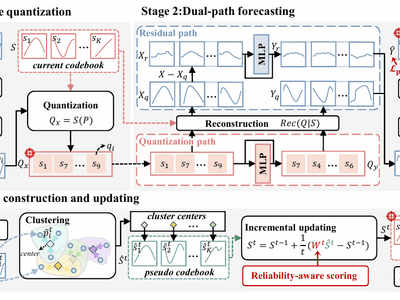
Time series forecasting is crucial for applications in various domains. Conventional methods often rely on global decomposition into trend, seasonal, and residual components, which become ineffective for real-world series dominated by local, complex, and highly dynamic patterns. Moreover, the high model complexity of such approaches limits their applicability in real-time or resource-constrained environments. In this work, we propose a novel reliability-aware codebook-assisted time series forecasting framework (ReCast) that enables lightweight and robust prediction by exploiting recurring local shapes. ReCast encodes local patterns into discrete embeddings through patch-wise quantization using a learnable codebook, thereby compactly capturing stable regular structures. To compensate for residual variations not preserved by quantization, ReCast employs a dual-path architecture comprising a quantization path for efficient modeling of regular structures and a residual path for reconstructing irregular fluctuations. A central contribution of ReCast is a reliability-aware codebook update strategy, which incrementally refines the codebook via weighted corrections. These correction weights are derived by fusing multiple reliability factors from complementary perspectives by a distributionally robust optimization (DRO) scheme, ensuring adaptability to non-stationarity and robustness to distribution shifts. Extensive experiments demonstrate that ReCast outperforms state-of-the-art (SOTA) models in accuracy, efficiency, and adaptability to distribution shifts.

† 共同贡献 · * 通讯作者
DOI ↗访问成果 ↗
期刊论文CCF-A
迈向可靠学习:半监督医学图像分割的锚定与控制方法

迈向可靠学习: 半监督医学图像分割的锚定与控制方法

SSI

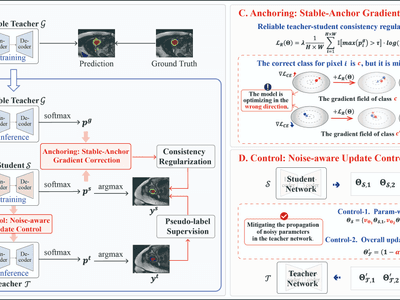
在半监督医学图像分割中, 对未标记数据的稳定, 可控利用是影响模型性能的重要因素. 目前主流方法多采用教师–学生框架, 并通过指数移动平均由学生模型平滑更新教师参数. 然而, 当伪标签质量不佳时, 学生模型梯度优化方向会受到影响; 更为严重的是, 在指数移动平均更新机制下, 教师模型会被动地进行错误参数更新, 从而导致误差逐步累积与放大, 最终削弱整个训练过程的稳定性与可靠性. 本文提出了一种面向可靠学习的半监督医学图像分割方法, 即锚定控制 (Anchoring and Control, AnCo) 框架, 通过锚定与控制机制的协同作用, 有效抑制训练过程中的噪声传播, 从而提升模型的稳定性与可靠性. (1)基于稳定锚点的梯度修正: 将在有标签数据上预训练的教师模型作为稳定锚点, 设计基于可靠教师-学生一致性的正则化项来修正噪声伪标签对学生模型训练梯度的影响, 并从理论上证明了该方法的有效性; (2)基于噪声感知的参数更新控制: 教师模型在参数更新过程中, 依据学生参数的可靠性对教师模型的参数更新进行主动筛选与自适应调节, 从而有效抑制噪声传播, 提升训练过程的稳定性与鲁棒性. 在多个2D/3D医学图像分割基准上进行了大量实验, 结果表明了AnCo的有效性和泛化能力, 并显著超越现有最先进方法.

† 共同贡献 · * 通讯作者

DOI ↗访问成果 ↗
期刊论文SCI一区 · CCF-B
Common Pattern Prior-Driven Semi-Supervised Medical Image Segmentation

Common Pattern Prior-Driven Semi-Supervised Medical Image Segmentation

TMI

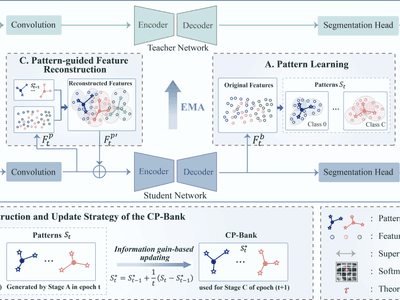
Semi-supervised learning (SSL) has emerged as a promising paradigm for medical image segmentation, aiming to alleviate the scarcity of high-quality annotations by combining limited labeled and abundant unlabeled data. However, existing SSL methods suffer from inherent limitations: 1) consistency regularization overly relies on enforcing prediction consistency under different perturbations, neglecting deep exploration of semantic and discriminative features; 2) pseudo-labeling methods are prone to introducing noise, which in turn undermines the stability of model training. To enable high-quality and more stable model learning, we propose a common pattern prior-driven network (CPP-Net) for semi-supervised medical image segmentation. To improve training quality, CPP-Net proposes a pattern learning mechanism that extracts each class’s core semantic information for high-quality feature learning. At its core, it is a dynamically updated common pattern bank (CP-Bank), which stores class-specific patterns learned throughout training and serves as high-quality prior knowledge for the model. By reusing CP-Bank patterns, CPP-Net reconstructs current-stage features, reduces redundant learning of shared patterns, and boosts feature robustness and discriminability. Furthermore, an information gain-driven update strategy is proposed to ensure that the CP-Bank is aligned with the historical mean of pattern distributions, preventing excessive bias toward transient local patterns. To enhance training stability, a dynamic regulation function is designed to adaptively modulate the impact of pseudo-labels according to their confidence, thereby mitigating the adverse effects of low-confidence data. Through extensive experiments on various 2D/3D medical image segmentation datasets, CPP-Net demonstrates its effectiveness and generalizability, and achieves 7.5% mean Dice improvement over SOTA.

† 共同贡献 · * 通讯作者

DOI ↗访问成果 ↗
期刊论文SCI一区 · CCF-C
ICMBS-Former: Skin Lesion Segmentation via Boundary-Region Collaborative Optimization

ICMBS-Former: Skin Lesion Segmentation via Boundary-Region Collaborative Optimization

Expert Syst Appl

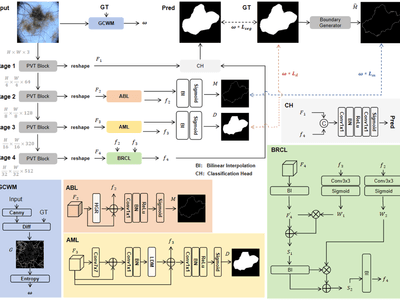
The segmentation of skin lesions is crucial to computer-aided analysis of dermoscopic images. However, dermoscopic images often suffer from hair occlusion, diverse lesion appearances, and various confounding factors such as rulers and vignetting. These issues significantly affect lesion diagnosis and analysis accuracy. This paper introduces a novel method called ICMBS-Former, designed to achieve accurate segmentation of dermoscopic images through two key strategies. (1) The introduction of a boundary-region collaborative optimization mechanism. With joint modeling of region and boundary features, the integrity of the lesion area is maintained while enhancing the boundaries, thus solving the problems of fuzzy boundaries caused by hair occlusion and diverse lesion structure modeling. (2) To deal with the interference from confounding factors, a complexity quantification method based on entropy has been proposed. With high weights assigned to complex background images, the model can focus better on complex scenes during training, improving the accuracy of segmenting skin lesions. Experiments on three skin lesion datasets demonstrate that ICMBS-Former outperforms state-of-the-art methods on six key metrics. The method achieves improvements in DSC of 2.74% and in mIoU of 4.43% over existing methods. Also, ICMBS-Former shows excellent generalization and significant improvements over recent models in polyp segmentation.

† 共同贡献 · * 通讯作者

访问成果 ↗
期刊论文SCI一区 · CCF-B
ERN: An edge reconstruction network for image super-resolution diffusion model

ERN: An edge reconstruction network for image super-resolution diffusion model

KBS

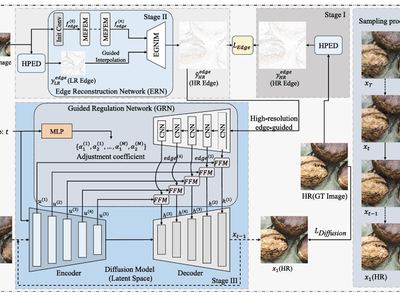
Image super-resolution aims to enhance the detail representation and visual clarity of low-resolution images. Although latent diffusion model (LDM)-based super-resolution approaches have achieved remarkable progress, their use of aggressive downsampling to compress degraded images into the latent space often results in loss of high-frequency details, thereby limiting the structural fidelity of the reconstructed images. To address this, we propose a plug-and-play Edge Reconstruction Network (ERN) that recovers high-resolution edge prior from low-resolution inputs. By explicitly including this high-resolution edge prior as structural priors in the diffusion process, the model’s ability to reconstruct high-frequency details can be greatly improved. In ERN, new edges of images are calculated using edge pixels. Since edge pixels are treated as discrete sampling points on the edge curve, the neural network interpolates edge pixels only, effectively eliminating non-edge information interference, thereby reducing jagged edges and block artifacts. In addition, the network’s reconstruction accuracy and robustness in complex structure scenes improve significantly as it learns the mapping between low-resolution images and their corresponding high-resolution edge images. Another key contribution is an automatic label generation method based on surface fitting, which extracts edge labels with quadratic polynomial accuracy from GT images, providing reliable supervision for edge reconstruction and alleviating the scarcity of high-quality edge labels. Extensive experiments demonstrate ERN’s effectiveness on SR task. It can be seamlessly integrated into existing LDM-based methods, with only ∼ 15M additional parameters yielding a 0.1 dB ∼ 1.2 dB PSNR gain, achieving a favorable balance between performance and computational cost.

† 共同贡献 · * 通讯作者

DOI ↗访问成果 ↗
会议论文CCF-A
Aligning the True Semantics: Constrained Decoupling and Distribution Sampling for Cross-Modal Alignment

Aligning the True Semantics: Constrained Decoupling and Distribution Sampling for Cross-Modal Alignment

AAAI

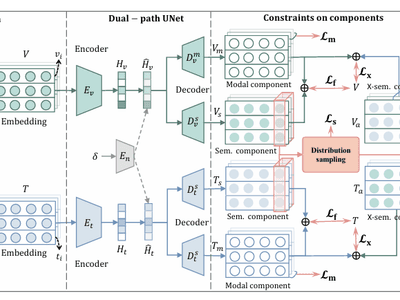
Cross-modal alignment is a crucial task in multimodal learning aimed at achieving semantic consistency between vision and language. This requires that image-text pairs exhibit similar semantics. Traditional algorithms pursue embedding consistency to achieve semantic consistency, ignoring the non-semantic information present in the embedding. An intuitive approach is to decouple the embeddings into semantic and modality components, aligning only the semantic component. However, this introduces two main challenges: (1) There is no established standard for distinguishing semantic and modal information. (2) The modality gap can cause semantic alignment deviation or information loss. To align the true semantics, we propose a novel cross-modal alignment algorithm via \textbf{C}onstrained \textbf{D}ecoupling and \textbf{D}istribution \textbf{S}ampling (CDDS). Specifically, (1) A dual-path UNet is introduced to adaptively decouple the embeddings, applying multiple constraints to ensure effective separation. (2) A distribution sampling method is proposed to bridge the modality gap, ensuring the rationality of the alignment process. Extensive experiments on various benchmarks and model backbones demonstrate the superiority of CDDS, outperforming state-of-the-art methods by 6.6\% to 14.2\%.

† 共同贡献 · * 通讯作者

DOI ↗访问成果 ↗
期刊论文CCF-A
用于超像素分割的边缘增强状态空间模型

用于超像素分割的边缘增强状态空间模型

CJC

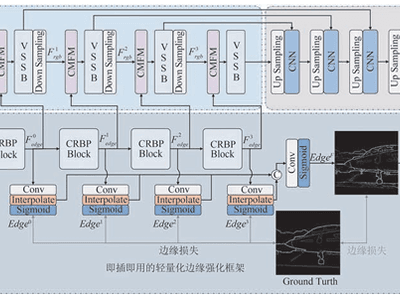
超像素分割算法通过聚合颜色及低级特征相似的像素,可以大幅减小计算机视觉任务中的处理对象数量,提高其计算效率.受限于CNN较小的感受野,现有的基于CNN的超像素分割方法在理解图像全局结构时存在一定的限制.此外,由于大多数方法依赖隐式学习来推断物体边界,导致其在复杂边界和弱边缘区域的分割效果不佳.并且,仅使用两个损失函数的简单加权来训练网络也限制了分割准确性和超像素形状规则性之间平衡的优化.在这项研究中,我们利用所提出的EE-SSM模型来解决长程空间依赖建模,复杂边界处理以及规则性和准确性二者间的平衡的挑战.通过一个基于状态空间模型构建的编码器和一个基于边界概率的自适应损失函数,EE-SSM实现了高精度的分割,能够在保持超像素规则性的同时维持边界的紧密贴合.论文的关键贡献是一个新颖的即插即用的轻量级边缘强化框架.该框架通过为编码过程提供显式的边缘特征,显著提升模型在处理复杂边界时的能力.通过在多个真实世界的图像数据集上进行广泛实验,EE-SSM展示了其卓越的有效性和鲁棒性.与近两年最先进的方法相比,EE-SSM在BR和UE指标上分别实现了2.41%-18.65%和14.00%-14.32%的显著提升.

† 共同贡献 · * 通讯作者

DOI ↗访问成果 ↗
期刊论文SCI二区 · CCF-B
TD-HCN: A trend-driven hypergraph convolutional network for stock return prediction

TD-HCN: A trend-driven hypergraph convolutional network for stock return prediction

NN

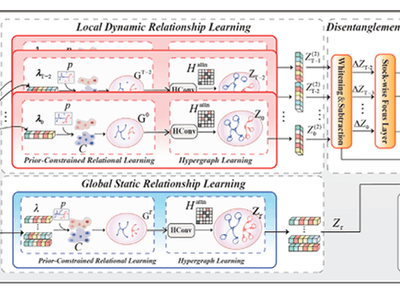
Stock data analysis has become one of the most challenging tasks in time series data analysis due to its dynamism, complexity, and nonlinearity. Recently, relational graphs have become popular for describing certain important relationships in data, particularly by mapping indirect and direct relationships between stocks into non-Euclidean spaces. Existing graph-based methods mainly capture simple pairwise and static relationships between stocks, so they cannot effectively identify higher-order relationships and characterize the dynamic trends of stock relationships. This limitation restricts the performance of stock return prediction models. A variety of stock data types reveal complex relationships among stocks, such as stock prices, industry links, and wiki relationships. This paper proposes a novel Trend-Driven Hypergraph Convolutional Network (TD-HCN) that integrates these data types in order to predict stock rankings through a cooperative learning method of local dynamic and global static relationships across temporal dimensions. To be concrete, we employ a Prior-constrained Relational Learning (PCRL) model that leverages explicit prior knowledge to guide the discovery of latent high-order relationships among stocks. In order to comprehensively capture and utilize dynamic trends in relationships among stocks, a Disentanglement Representation Learning (DRL) mechanism is developed to enhance the key trend features through the disentanglement operation and dual attention module. Extensive experiments on NASDAQ and NYSE datasets show that TD-HCN consistently outperforms the state-of-the-art methods by a considerable margin in terms of returns. It is also effective and robust in learning the dynamic relationships among stocks and capturing key changes in trends within those relationships.

† 共同贡献 · * 通讯作者

DOI ↗访问成果 ↗
期刊论文SCI 2区
Deformable 1D Directional Convolution with Bidirectional Offsets for Oriented Object Detection

Deformable 1D Directional Convolution with Bidirectional Offsets for Oriented Object Detection

RS

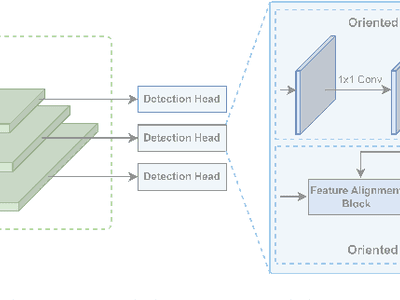
Oriented object detection is an important and challenging task in the field of image processing and computer vision. The main challenge in detecting oriented objects comes from their high aspect ratio and being distributed with arbitrary orientations. Various methods have been developed to handle this issue. However, most existing works rely on time-consuming rotation and interpolation operations to align the feature representations of oriented objects. To avoid these operations, in this paper, we first introduce a simple yet effective deformable 1D directional convolution (D1DD-Conv), which implements a rotated convolution by deforming the 1D convolution kernel with horizontal and vertical offsets. Based upon this directional convolution, we then design a tri-branch convolution layer and integrate D1DD-Conv into the feature pyramid network for extracting the directional features of objects. Furthermore, we present a deep model to deal with the oriented object detection task. By allowing the offsets only along with horizontal and vertical directions, D1DD-Conv essentially corresponds to a rotated 1D convolution but without any rotation operations. This simple design is beneficial for efficiently capturing the orientation features of different oriented objects, leading to accurate prediction of the oriented bounding box of each oriented object. Some experiments on three popular datasets show that our model can achieve superior detection performance.

DOI ↗访问成果 ↗

2025

7 项成果
期刊论文SCI一区 · CCF-C
TSCG: Efficient grouped channel interaction for multivariate time series forecasting

TSCG: Efficient grouped channel interaction for multivariate time series forecasting

Expert Syst Appl

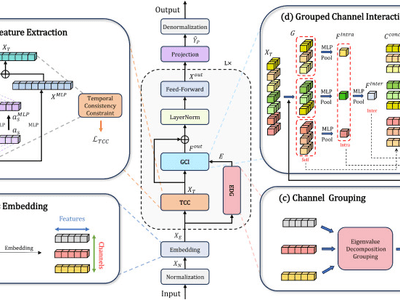
In multivariate time series, different channels describe distinct features of the data and are often interrelated in complex ways. Interactions between channels can effectively utilize their correlations and common information, improving the model’s capacity to capture the underlying structure of the data. However, direct interactions between channels with low correlation may introduce irrelevant noise, which degrades forecasting accuracy. Conventional channel grouping methods based on correlation often lead to overlapping representations of information across groups, resulting in features after channel interactions that overemphasize redundant information. In this study, we propose a novel Time Series Channel Grouping model (TSCG), which addresses the tasks of multi-channel interaction in multivariate time series forecasting through temporal consistency constraint strategy and channel grouping and feature interaction strategy. The primary contribution is a channel grouping method based on principal component orthogonality, which reduces redundant information in the channel interaction process by ensuring significant differences in the representations of different groups. Based on the grouping results, intra-group channel interactions model highly correlated intra-group features, while inter-group channel interactions capture global features that cover all channels. Additionally, during time series feature extraction, a constraint based on statistical features and temporal dependencies is introduced to maintain temporal consistency before and after feature extraction, ensuring the effective transmission of temporal information. TSCG demonstrates its effectiveness and robustness across various real-world datasets, achieving improvements of 7.0 % and 5.3 % over state-of-the-art methods, and offering a new perspective on channel interaction tasks.

† 共同贡献 · * 通讯作者

DOI ↗访问成果 ↗
期刊论文SCI二区 · CCF-B
MDWConv:CNN based on multi-scale atrous pyramid and depthwise separable convolution for long time series forecasting

MDWConv:CNN based on multi-scale atrous pyramid and depthwise separable convolution for long time series forecasting

NN

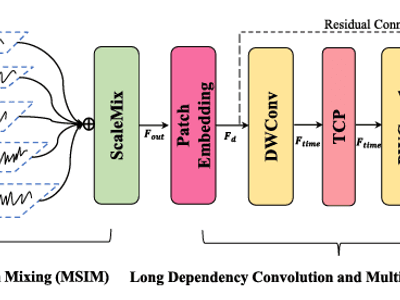
Long time series forecasting has extensive applications in various fields such as power dispatching, traffic control, and weather forecasting. Recently, models based on the Transformer architecture have dominated the field of time series forecasting. However, these methods lack the ability to handle the correlation of multi-scale information and the interaction of information between variables in model design. This paper proposes a convolutional neural network, MDWConv, based on multi-scale dilated pyramid and depthwise separable convolution. In terms of understanding and integrating multi-scale information, the multi-scale dilated pyramid structure is constructed to capture multi-scale features, and convolution operations are employed to achieve cross-scale information integration, thereby improving the understanding and processing capability of the sequence’s rich scale-specific information. A depthwise separable convolution network is constructed, which adopts a grouping strategy: using depthwise convolution to extract long-term dependencies and pointwise convolution for inter-variable information interaction and hidden information extraction. This reduces computational complexity while improving the model’s predictive accuracy through enhanced feature representation. We also propose a novel segmented polynomial activation function (TCP), which approximates the GELU function with piecewise cubic Hermite functions in different domains, significantly reducing computational complexity and achieving a faster loss reduction rate. Experiments on various real-world datasets demonstrate that MDWConv outperforms other methods. Despite relying solely on convolutional neural networks, MDWConv still exhibits strong competitiveness.

† 共同贡献 · * 通讯作者

DOI ↗访问成果 ↗
会议论文CCF A类
MPR-Net:Multi-Scale Pattern Reproduction Guided Time Series Forecasting

MPR-Net:Multi-Scale Pattern Reproduction Guided Time Series Forecasting

IJCAI

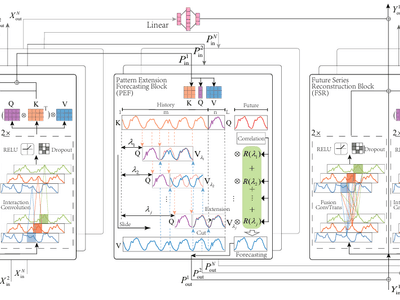
Time series forecasting has received wide interest from existing research due to its broad applications and inherent challenging. The research challenge lies in identifying effective patterns in historical series and applying them to future forecasting. Advanced models based on point-wise connected MLP and Transformer architectures have strong fitting power, but their secondary computational complexity limits practicality. Additionally, those structures inherently disrupt the temporal order, reducing the information utilization and making the forecasting process uninterpretable. To solve these problems, this paper proposes a forecasting model, MPR-Net. It first adaptively decomposes multi-scale historical series patterns using convolution operation, then constructs a pattern extension forecasting method based on the prior knowledge of pattern reproduction, and finally reconstructs future patterns into future series using deconvolution operation. By leveraging the temporal dependencies present in the time series, MPR-Net not only achieves linear time complexity, but also makes the forecasting process interpretable. By carrying out sufficient experiments on more than ten real data sets of both short and long term forecasting tasks, MPR-Net achieves the state of the art forecasting performance, as well as good generalization and robustness performance.

† 共同贡献 · * 通讯作者

访问成果 ↗
会议论文CCF-A
Reliable Cross-modal Alignment via Prototype Iterative Construction

Reliable Cross-modal Alignment via Prototype Iterative Construction

MM

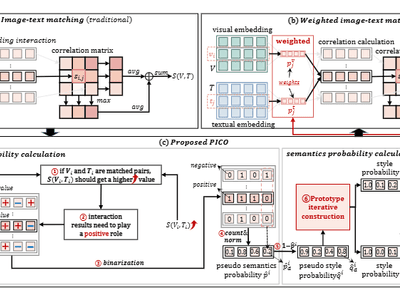
Cross-modal alignment is an important multi-modal task, aimingto bridge the semantic gap between different modalities. The mostreliable fundamention for achieving this objective lies in the se-mantic consistency between matched pairs. Conventional methodsimplicitly assume embeddings contain solely semantic information,ignoring the impact of non-semantic information during alignment,which inevitably leads to information bias or even loss. These non-semantic information primarily manifest as stylistic variations inthe data, which we formally define as style information. An intu-itive approach is to separate style from semantics, aligning only thesemantic information. However, most existing methods distinguishthem based on feature columns, which cannot represent the com-plex coupling relationship between semantic and style information.In this paper, we propose PICO, a novel framework for suppressingstyle interference during embedding interaction. Specifically, wequantify the probability of each feature column representing seman-tic information, and regard it as the weight during the embeddinginteraction. To ensure the reliability of the semantic probability, wepropose a prototype iterative construction method. The key oper-ation of this method is a performance feedback-based weightingfunction, and we have theoretically proven that the function canassign higher weight to prototypes that bring higher performanceimprovements. Extensive experiments on various benchmarks andmodel backbones demonstrate the superiority of PICO, outperform-ing state-of-the-art methods by 5.2%-14.1%.

† 共同贡献 · * 通讯作者

DOI ↗访问成果 ↗
期刊论文SCI一区 · CCF-C
Driven by textual knowledge: A Text-View Enhanced Knowledge Transfer Network for lung infection region segmentation

Driven by textual knowledge: A Text-View Enhanced Knowledge Transfer Network for lung infection region segmentation

Med Image Anal

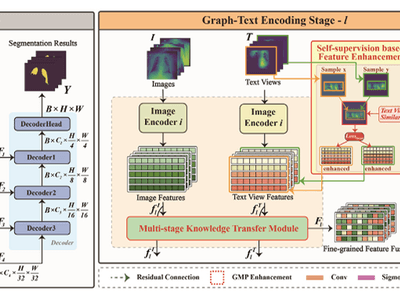
Lung infections are the leading cause of death among infectious diseases, and accurate segmentation of the infected lung area is crucial for effective treatment. Currently, segmentation methods that rely solely on imaging data have limited accuracy. Incorporating text information enriched with expert knowledge into the segmentation process has emerged as a novel approach. However, previous methods often used unified text encoding strategies for extracting textual features. It failed to adequately emphasize critical details in the text, particularly the spatial location of infected regions. Moreover, the semantic space inconsistency between text and image features complicates cross-modal information transfer. To close these gaps, we propose a Text-View Enhanced Knowledge Transfer Network (TVE-Net) that leverages key information from textual data to assist in segmentation and enhance the model’s perception of lung infection locations. The method generates a text view by probabilistically modeling the location information of infected areas in text using a robust, carefully designed positional probability function. By assigning lesion probabilities to each image region, the infected areas’ spatial information from the text view is explicitly integrated into the segmentation model. Once the text view has been introduced, a unified image encoder can be employed to extract text view features, so that both text and images are mapped into the same space. In addition, a self-supervised constraint based on text-view overlap and feature consistency is proposed to enhance the model’s robustness and semi-supervised capability through feature augmentation. Meanwhile, the newly designed multi-stage knowledge transfer module utilizes a globally enhanced cross-attention mechanism to comprehensively learn the implicit correlations between image features and text-view features, enabling effective knowledge transfer from text-view features to image features. Extensive experiments demonstrate that TVE-Net outperforms both unimodal and multimodal methods in both fully supervised and semi-supervised lung infection segmentation tasks, achieving significant improvements on QaTa-COV19 and MosMedData+ datasets.

† 共同贡献 · * 通讯作者
DOI ↗访问成果 ↗
会议论文CCF-A
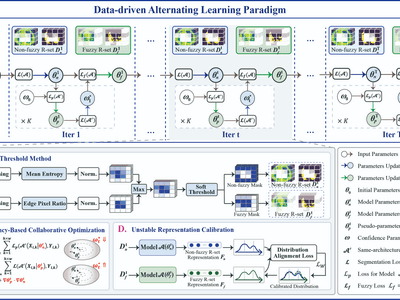
Minding Fuzzy Regions: A Data-driven Alternating Learning Paradigm for Stable Lesion Segmentation

Minding Fuzzy Regions: A Data-driven Alternating Learning Paradigm for Stable Lesion Segmentation

CVPR

Deep learning has achieved significant advancements in medical image segmentation, but existing models still face challenges in accurately segmenting lesion regions. The main reason is that some lesion regions in medical images have unclear boundaries, irregular shapes, and small tissue density differences, leading to label ambiguity. However, the existing model treats all data equally without taking quality differences into account in the training process, resulting in noisy labels negatively impacting model training and unstable feature representations. In this paper, a data-driven alternating learning (DALE) paradigm is proposed to optimize the model's training process, achieving stable and high-precision segmentation. The paradigm focuses on two key points: (1) reducing the impact of noisy labels, and (2) calibrating unstable representations. To mitigate the negative impact of noisy labels, a loss consistency-based collaborative optimization method is proposed, and its effectiveness is theoretically demonstrated. Specifically, the label confidence parameters are introduced to dynamically adjust the influence of labels of different confidence levels during model training, thus reducing the influence of noise labels. To calibrate the learning bias of unstable representations, a distribution alignment method is proposed. This method restores the underlying distribution of unstable representations, thereby enhancing the discriminative capability of fuzzy region representations. Extensive experiments on various benchmarks and model backbones demonstrate the superiority of the DALE paradigm, achieving an average performance improvement of up to 7.16%.

† 共同贡献 · * 通讯作者

DOI ↗访问成果 ↗
期刊论文
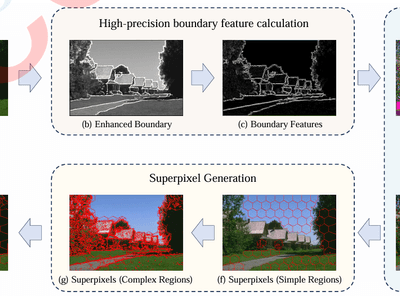
高精度边界驱动与图像内容自适应的超像素分割方法

高精度边界驱动与图像内容自适应的超像素分割方法

TVC

超像素生成算法是计算机视觉中的重要研究内容. 现有方法生成的超像素大多呈近乎均匀分布, 在图像结构简单的区域会产生超像素冗余, 而在结构复杂区域则无法提供足够的超像素以表达细节. 这一问题在只使用较少超像素进行分割时尤为突出, 影响了分割的准确性. 超像素合理分配的基础是对图像结构复杂度的精确感知,分割的准确性则依赖于高质量的边界特征. 在本研究中, 我们提出了结合边界驱动与内容自适应(Boundary-Driven and Content-Adaptive, BDCA)的方法, 以应对低数量超像素分割的挑战. BDCA聚焦于两个关键点: (1)高精度边界驱动; (2)图像内容自适应. 为获取高质量边缘, 提出基于深度学习和数值拟合相结合的方法计算边界特征,该方法使用深度学习模型获取的边缘显式增强图像中的物体轮廓, 并采用二次多项式精度的曲面计算边缘特征, 从而使提取的边缘完整性好并且精度高, 为聚类和超像素生成提供有效约束. 为了根据图像的复杂度自适应调整种子点的分布, BDCA首先基于边缘特征约束进行聚类, 并基于聚类结果对图像内容进行感知, 来判定图像的简单区域和复杂区域. 在结构简单区域以尽可能少的种子点生成规则且稀疏的超像素, 在结构复杂区域采用相对多的种子点以提高分割的准确性. 特别是, 新设计的自适应距离函数, 可以根据图像的局部方差自适应调整权重, 使结构复杂区域的超像素精准地贴合物体边界. 与最先进的方法相比, 新方法生成的超像素精度高, 且规则性良好. 我们将在接受后发布代码.

DOI ↗访问成果 ↗

2024

12 项成果
期刊论文SCI二区 · CCF-B
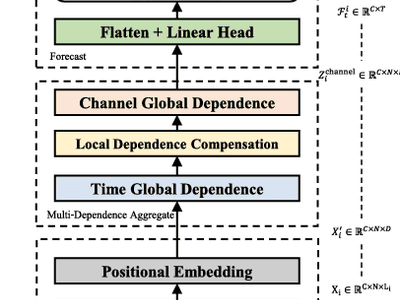
Multi-scale convolution enhanced transformer for multivariate long-term time series forecasting

Multi-scale convolution enhanced transformer for multivariate long-term time series forecasting

NN

In data analysis and forecasting, particularly for multivariate long-term time series, challenges persist. The Transformer model in deep learning methods has shown significant potential in time series forecasting. The Transformer model’s dot-product attention mechanism, however, due to its quadratic computational complexity, impairs training and forecasting efficiency. In addition, the Transformer architecture has limitations in modeling local features and dealing with multivariate cross-dimensional dependency relationship. In this article, a Multi-Scale Convolution Enhanced Transformer model (MSCformer) is proposed for multivariate long-term time series forecasting. As an alternative to modeling the time series in its entirety, a segmentation strategy is designed to convert the input original series into segmented forms with different lengths, then process time series segments using a new constructed multi-Dependency Aggregation module. This multi-Scale segmentation approach reduces the computational complexity of the attention mechanism part in subsequent models, and for each segment of length corresponds to a specific time scale, it also ensures that each segment retains the semantic information of the data sequence level, thereby comprehensively utilizing the multi-scale information of the data while more accurately capturing the real dependency of the time series. The Multi-Dependence Aggregate module captures both cross-temporal and cross-dimensional dependencies of multivariate long-term time series and compensates for local dependencies within the segments thereby captures local series features comprehensively and addressing the issue of insufficient information utilization. MSCformer synthesizes dependency information extracted from various temporal segments at different scales and reconstructs future series using linear layers. MSCformer exhibits higher forecasting accuracy, outperforming existing methods in multiple domains including energy, transportation, weather, electricity, disease and finance.

† 共同贡献 · * 通讯作者

DOI ↗访问成果 ↗
期刊论文SCI二区 · CCF-B
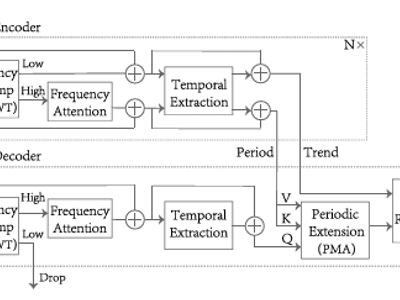
TFformer: A time–frequency domain bidirectional sequence-level attention based transformer for interpretable long-term sequence forecasting

TFformer: A time–frequency domain bidirectional sequence-level attention based transformer for interpretable long-term sequence forecasting

PR

Transformer methods have shown strong predictive performance in long-term time series prediction. However, its attention mechanism destroys temporal dependence and has quadratic complexity. This makes prediction processes difficult to interpret, limiting their application in tasks requiring interpretability. To address this issue, this paper proposes a highly interpretable long-term sequence forecasting model, TFformer. TFformer decomposes time series into low frequency trend component and high frequency period component by frequency decomposition, and forecasts them respectively. The periodic information in high-frequency component is enhanced with the sequential frequency attention, and then the temporal patterns of the two components are obtained by feature extraction. According to the period property in time domain, TFformer through periodic extension to predict the future period patterns using sequential periodic matching attention. Finally, the predicted future period pattern and the extracted trend pattern are reconstructed to future series. TFformer provides an interpretable forecasting process with low time complexity, as it retains temporal dependence using sequence-level attentions. TFformer achieves significant prediction performance in both univariate and multivariate forecasting across six datasets. Detailed experimental results and analyses verify the effectiveness and generalization of TFformer.

† 共同贡献 · * 通讯作者

DOI ↗访问成果 ↗
期刊论文SCI一区 · CCF-C
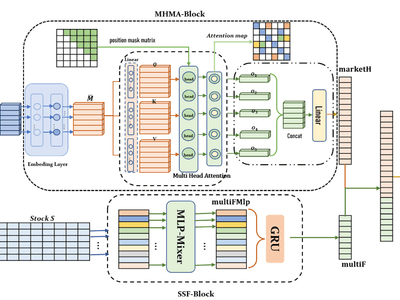
MDF-DMC: A stock prediction model combining multi-view stock data features with dynamic market correlation information

MDF-DMC: A stock prediction model combining multi-view stock data features with dynamic market correlation information

ESWA

Using machine learning coupled with stock price data to predict stock price trends has attracted increasing attention from data mining and machine learning communities. An accurate prediction results can help investors reduce investment risks and improve investment returns. The research on correlation stocks is one of the most important directions among many studies. Due to the high volatility and randomness of stock data, the correlation between stocks changes over time, which makes the stock correlation in static correlation stock sets often inconsistent with reality. Furthermore, various raw data related to stocks contain sufficient stock history information to analyze the future trend of stocks, but traditional prediction models cannot make good use of this information, which restricts the learning ability of the model and reduces the prediction accuracy. In this paper, we propose a stock prediction model combining multi-view stock data features with dynamic market correlation information (MDF-DMC). The model extracts stock trend features by combining multi-view raw data of a single stock with a Multi-layer Perceptron Mixer (MLP-Mixer); The improved Transformer encoder learns the correlation between the stock to be predicted and all the selected stocks in the stock market dynamically and extracts the features of the market correlation. We have conducted a large number of experiments on a total of 578 stocks in the stock markets of China and the United States, and the results show that our model has achieved excellent accuracy and returns across all data sets.

† 共同贡献 · * 通讯作者
DOI ↗访问成果 ↗
期刊论文SCI一区 · CCF-C
MWDINet: A multilevel wavelet decomposition interaction network for stock price prediction

MWDINet: A multilevel wavelet decomposition interaction network for stock price prediction

ESWA

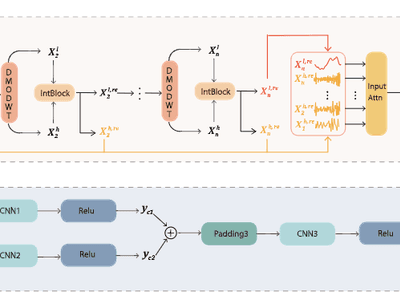
Stock price prediction is a classical interdisciplinary issue drawn from finance, computer science, econometrics, and mathematics. Most stock price data are nonlinear, nonstationary, and highly complex, making stock price prediction challenging. Recently, deep neural networks (DNNs) have demonstrated powerful learning capabilities and have yielded notable results in stock price prediction tasks. Most existing deep learning solutions, however, only consider time-domain information or lack effective modeling of frequency-domain information, thus failing to effectively utilize both time-domain and frequency-domain information of the data. Meanwhile, existing methods ignore autocorrelated errors in the stock price forecasting task due to missing valid information data, i.e., they do not consider the correlation between the error at the current time step and the error at the previous time step, which undermines the standard maximum likelihood estimation (MLE) assumption, thereby weakening the model’s performance. We propose a multilevel wavelet decomposition interaction network (MWDINet), an end-to-end framework for stock price prediction. MWDINet employs the multiscale wavelet decomposition interaction module (MWDI-Block) and the Hull Moving Average module (HMA-Block) to extract the data’s frequency-domain and time-domain information, respectively. In MWDI-Block, the traditional signal processing method of Maximum Overlapping Discrete Wavelet Transform (MODWT) is seamlessly embedded into a deep learning framework (named DMODWT). The DMODWT algorithm not only automatically extracts the frequency-domain information from the data, but also fine-tunes the wavelet filters. With HMA-Block, we improve the Hull Moving Average (HMA), commonly used in the industry, into a deep learning module, which learns how changes in different markets over time. Inspired by the research on correcting autocorrelated errors in linear models in econometrics, we further design a deep difference module (DIF-Block) to correct autocorrelated errors and thus improve the prediction performance of the model. Moreover, all components are integrated seamlessly in a unified end-to-end framework. Extensive experiments on real-world datasets demonstrate that MWDINet outperforms the state-of-the-art models and has remarkable potential in stock price prediction.

† 共同贡献 · * 通讯作者
DOI ↗访问成果 ↗
会议论文SCI一区 · CCF-A
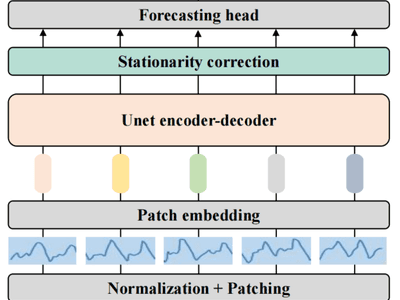
U-Mixer: An Unet-Mixer Architecture with Stationarity Correction for Time Series Forecasting

U-Mixer: An Unet-Mixer Architecture with Stationarity Correction for Time Series Forecasting

AAAI

We address the Individualized continuous treatment effect (ICTE) estimation problem where we predict the effect of any continuous valued treatment on an individual using ob- servational data. The main challenge in this estimation task is the potential confounding of treatment assignment with in- dividual’s covariates in the training data, whereas during in- ference ICTE requires prediction on independently sampled treatments. In contrast to prior work that relied on regularizers or unstable GAN training, we advocate the direct approach of augmenting training individuals with independently sam- pled treatments and inferred counterfactual outcomes. We in- fer counterfactual outcomes using a two-pronged strategy: a Gradient Interpolation for close-to-observed treatments, and a Gaussian Process based Kernel Smoothing which allows us to down weigh high variance inferences. We evaluate our method on five benchmarks and show that our method out- performs six state-of-the-art methods on the counterfactual estimation error. We analyze the superior performance of our method by showing that (1) our inferred counterfactual re- sponses are more accurate, and (2) adding them to the train- ing data reduces the distributional distance between the con- founded training distribution and test distribution where treat- ment is independent of covariates. Our proposed method is model-agnostic and we show that it improves ICTE accuracy of several existing models.

† 共同贡献 · * 通讯作者
DOI ↗访问成果 ↗
期刊论文SCI一区 · CCF-C
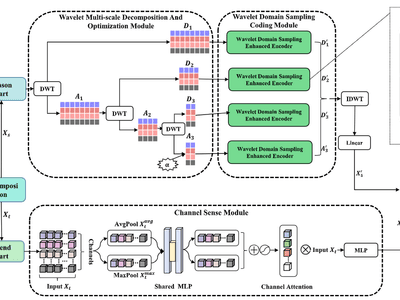
MultiWaveNet: A long time series forecasting framework based on multi-scale analysis and multi-channel feature fusion

MultiWaveNet: A long time series forecasting framework based on multi-scale analysis and multi-channel feature fusion

ESWA

Long time series forecasting is widely used in areas such as power dispatch, traffic control, and weather forecasting. The pattern of seasonality and trends in long time series are often complex, especially when they are presented at different time scales. Existing methods typically focus on only one scale or randomly select scales, which leads to a significant loss of valuable information. Additionally, current methods often transform multi-channel data into a single-channel format, ignoring interactions and complex relationships between channels. The paper proposes MultiWaveNet, a novel long time series forecasting framework that addresses seasonality as well as trends separately. For the seasonal component, the framework uses multi-scale wavelet decomposition to generate subseries at multiple scales. A learnable optimization factor is introduced simultaneously to separate high-frequency components mixed in low-frequency series after wavelet decomposition. In order to reduce information redundancy and model complexity, the paper develops a wavelet domain sampling encoder that consists of just one Transformer encoder, ensuring effective modeling of long-term dependencies while maintaining feature extraction effectiveness. As for the trend component, unlike previous research, the weights of channels are adjusted based on their importance, allowing the more crucial channels to have a greater impact and thereby addressing the limitations of individual processing methods. The paper performs extensive experiments on nine standard datasets, demonstrating that MultiWaveNet is the most competitive method.

† 共同贡献 · * 通讯作者
DOI ↗访问成果 ↗
期刊论文SCI一区 · CCF-B
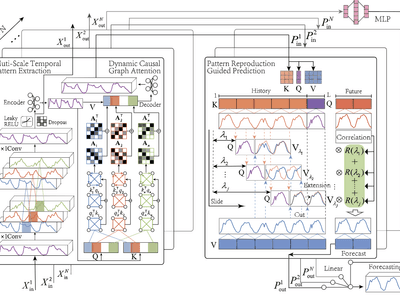
Diff-MGR: Dynamic causal graph attention and pattern reproduction guided diffusion model for multivariate time series probabilistic forecasting

Diff-MGR: Dynamic causal graph attention and pattern reproduction guided diffusion model for multivariate time series probabilistic forecasting

INS

Time series probability forecasting provides insight into future evolution and its inherent uncertainty from past data. In order to obtain more accurate forecasting as the reliable basis for future decision-making and planning, a new probabilistic prediction model of multivariate time series Diff-MGR is proposed in this study. Diff-MGR innovatively proposes dynamic causal graph attention blocks and pattern reproduction guided prediction blocks to predict the future patterns. Compared with the existing methods, the former captures dynamic unidirectional information flow by using causal graph structure at different periods to provide a real representation of variable relationships. The latter completes a reliable mapping of historical patterns to the future based on the prior knowledge of pattern reproduction. Furthermore, Diff-MGR proposes a novel noise prediction network that can effectively capture dependencies in predicted future patterns and generate probability distributions of future sequences using a conditional diffusion model. Extensive experiments on several real datasets verify the effectiveness of Diff-MGR's components, and show it outperforms existing models in probabilistic forecasting performance.

† 共同贡献 · * 通讯作者
DOI ↗访问成果 ↗
期刊论文SCI一区 · CCF-B
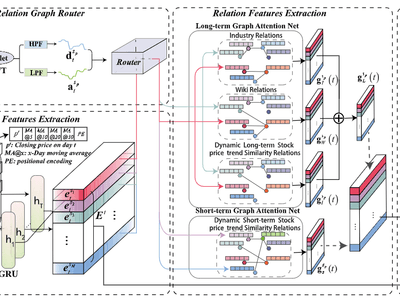
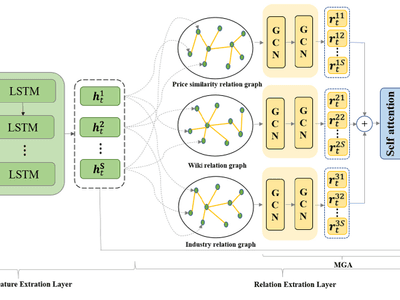
DR-GAT: Dynamic routing graph attention network for stock recommendation

DR-GAT: Dynamic routing graph attention network for stock recommendation

INS

Investors are increasingly interested in using financial technology to guide investment decisions. The phenomenon of “stock linkage” or “leading-lag” is often observed between related stocks on the stock market. Based on this feature of the stock market, complex relationships between stocks influence investment decisions. Existing methods use static prior relational data (e.g., industry relations and Wiki relations) to build corporate relation graph, while learning relational features using the same graph for all stocks. This description and use of corporate relationships ignored the dynamic nature of association relationships in time and space, limiting the ability to learn latent relationships between stocks. To address these issues, we propose a Dynamic Routing Graph Attention Network (DR-GAT) for stock recommendation. We propose a novel similarity measurement method called stock price trend similarity. To track the evolution of intercorporate relationships over time, we dynamically construct relation graph attention networks using prior knowledge and stock price trend similarity. Moreover, a newly designed relation graph router (RGR) can route each stock to an optimal relationship graph based on its volatility. Extensive experiments demonstrate the superiority of our DR-GAT method. It outperforms state-of-the-art methods achieving an average return ratio of 152% and 162% on NASDAQ and NYSE, respectively.

† 共同贡献 · * 通讯作者
DOI ↗访问成果 ↗
期刊论文CCF-A · CCF-A
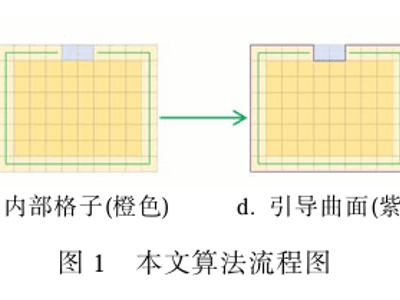
鲁棒的水密流形网格修复

鲁棒的水密流形网格修复

计算机辅助设计与图形学学报

针对未经修复的网格模型一般存在非流形结构, 常带有孔洞、法向不一致、自交等缺陷, 很难直接应用到后续基于网格的应用中的问题, 提出一种保持输入网格特征的鲁棒水密流形网格修复算法. 首先利用Manifoldplus算法和卷绕数(winding number)构建能够区分输入网格内外且逼近输入网格的水密流形引导曲面; 然后利用引导曲面计算受限Voronoi图(restricted Voronoi diagram, RVD); 再通过对偶得到受限三角剖分(restricted Delaunay triangulation, RDT); 将非流形问题分解到RVD和RDT计算过程中, 保证计算的RDT即为修复后的水密流形网格; 最后在原始网格边中添加辅助点, 保持原始网格特征. 基于Windows 10平台, 在ModelNet10公开数据集上进行实验的结果表明, 所提算法在输出网格的平均精度为1.54× 10⁻⁶, 与Manifoldplus算法相当; 但是当输入的模型包含孔洞时, Manifoldplus算法无法将孔洞合理地填补, 而该算法能够合理地填补孔洞.

† 共同贡献 · * 通讯作者
DOI ↗访问成果 ↗
会议论文CCF-A
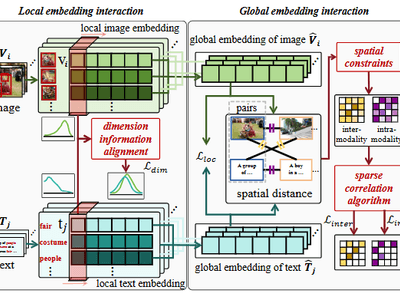
Bridging the Modality Gap: Dimension Information Alignment and Sparse Spatial Constraint for Image-Text Matching

Bridging the Modality Gap: Dimension Information Alignment and Sparse Spatial Constraint for Image-Text Matching

MM

Many contrastive learning based models have achieved advanced performance in image-text matching tasks. The key of these models lies in analyzing the correlation between image-text pairs, which involves cross-modal interaction of embeddings in corresponding dimensions. However, the embeddings of different modalities are from different models or modules, and there is a significant modality gap. Directly interacting such embeddings lacks rationality and may capture inaccurate correlation. Therefore, we propose a novel method called DIAS to bridge the modality gap from two aspects: (1) We align the information representation of embeddings from different modalities in corresponding dimension to ensure the correlation calculation is based on interactions of similar information. (2) The spatial constraints of inter- and intra-modalities unmatched pairs are introduced to ensure the effectiveness of semantic alignment of the model. Besides, a sparse correlation algorithm is proposed to select strong correlated spatial relationships, enabling the model to learn more significant features and avoid being misled by weak correlation. Extensive experiments demonstrate the superiority of DIAS, achieving 4.3%-10.2% rSum improvements on Flickr30k and MSCOCO benchmarks.

† 共同贡献 · * 通讯作者
DOI ↗访问成果 ↗
期刊论文SCI 4区
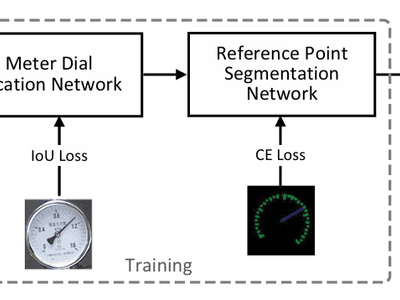
Pointer Meter Reading Recognition by Joint Detection and Segmentation

Pointer Meter Reading Recognition by Joint Detection and Segmentation

Appl. Sci.

To handle the task of pointer meter reading recognition, in this paper, we propose a deep network model that can accurately detect the pointer meter dial and segment the pointer as well as the reference points from the located meter dial. Specifically, our proposed model is composed of three stages: meter dial location, reference point segmentation, and dial number reading recognition. In the first stage, we translate the task of meter dial location into a regression task, which aims to separate bounding boxes by an object detection network. This results in the accurate and fast detection of meter dials. In the second stage, the dial region image determined by the bounding box is further processed by using a deep semantic segmentation network. After that, the segmented output is used to calculate the relative position between the pointer and reference points in the third stage, which results in the final output of reading recognition. Some experiments were conducted on our collected dataset, and the experimental results show the effectiveness of our method, with a lower computational burden compared to some existing works.

† 共同贡献 · * 通讯作者
DOI ↗访问成果 ↗
期刊论文CCF-B · CCF-B
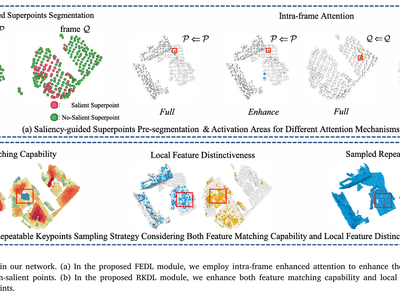
D3Former: Jointly learning repeatable dense detectors and feature-enhanced descriptors via saliency-guided transformer

D3Former: Jointly learning repeatable dense detectors and feature-enhanced descriptors via saliency-guided transformer

CAD

Establishing accurate and representative matches is a crucial step in addressing the point cloud registration problem. A commonly employed approach involves detecting keypoints with salient geometric features and subsequently mapping these keypoints from one frame of the point cloud to another. However, methods within this category are hampered by the repeatability of the sampled keypoints. In this paper, we introduce a saliency-guided transformer, referred to as D3Former, which entails the joint learning of repeatable Dense Detectors and feature-enhanced Descriptors. The model comprises a Feature Enhancement Descriptor Learning (FEDL) module and a Repetitive Keypoints Detector Learning (RKDL) module. The FEDL module utilizes a region attention mechanism to enhance feature distinctiveness, while the RKDL module focuses on detecting repeatable keypoints to enhance matching capabilities. Extensive experimental results on challenging indoor and outdoor benchmarks demonstrate that our proposed method consistently outperforms state-of-the-art point cloud matching methods. Notably, tests on 3DLoMatch, even with a low overlap ratio, show that our method consistently outperforms recently published approaches such as RoReg and RoITr. For instance, with the number of extracted keypoints reduced to 250, the registration recall scores for RoReg, RoITr, and our method are 64.3%, 73.6%, and 76.5%, respectively.

† 共同贡献 · * 通讯作者
DOI ↗访问成果 ↗

2023

9 项成果
期刊论文SCI一区 · CCF-B
Stock ranking prediction using a graph aggregation network based on stock price and stock relationship information

Stock ranking prediction using a graph aggregation network based on stock price and stock relationship information

Inform Sciences

The volatility of stock prices makes it difficult to predict stock price trends correctly. This volatility is affected by many factors, including other stocks related to it. Stock prediction based on graph learning uses various graph neural networks to learn how stocks interact to provide more information. However, they tend to adopt statically defined stock relations based on prior knowledge (such as industry relations and Wiki relations), making it difficult to capture the interplay between stocks over time. In addition, their predictions mostly rely on a single stock relationship, while many types of stock relationships affect the volatility of stock prices in a complex and intertwined manner. A new price similarity relation graph is first constructed using the multi-view stock price similarity to capture dynamic stock relationships. Based on three stock graphs (price similarity, Wiki and industry), we further propose a multi-relational graph attention ranking (MGAR) network. In MGAR, the multi-graph aggregation is achieved by applying adaptive learning mechanisms, thereby forming effective relation embeddings. When combined with the captured price trend embedding, MGAR model gives a ranking list of future returns and chooses K stocks with the best returns to trade so that the return on investment is maximized. Extensive experiments demonstrate that MGAR method outperforms state-of-the-art stock predicting solutions, achieving average returns of 164% and 236% on two real datasets, respectively.

† 共同贡献 · * 通讯作者
DOI ↗访问成果 ↗
期刊论文SCI一区 · CCF-C
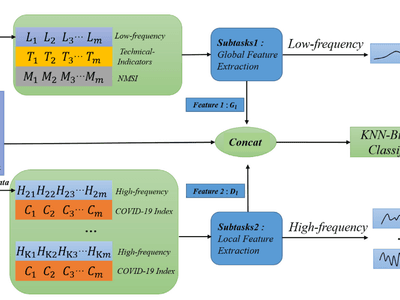
COVID19-MLSF: A multi-task learning-based stock market forecasting framework during the COVID-19 pandemic

COVID19-MLSF: A multi-task learning-based stock market forecasting framework during the COVID-19 pandemic

ESWA

The sudden outbreak of COVID-19 has dramatically altered the state of the global economy, and the stock market has become more volatile and even fallen sharply as a result of its negative impact, heightening investors’ apprehension regarding the correlation between unexpected events and stock market volatility. Additionally, internal and external characteristics coexist in the stock market. Existing research has struggled to extract more effective stock market features during the COVID-19 outbreak using a single time-series neural network model. This paper presents a framework for multitasking learning-based stock market forecasting (COVID-19-MLSF), which can extract the internal and external features of the stock market and their relationships effectively during COVID-19.The innovation comprises three components: designing a new market sentiment index (NMSI) and COVID-19 index to represent the external characteristics of the stock market during the COVID-19 pandemic. Besides, it introduces a multi-task learning framework to extract global and local features of the stock market. Moreover, a temporal convolutional neural network with a multi-scale attention mechanism is designed (MA-TCN) alongside a Multi-View Convolutional-Bidirectional Recurrent Neural Network with Temporal Attention (MVCNN-BiLSTM-Att), adjusting the model to account for the changing status of COVID-19 and its impact on the stock market. Experiments indicate that our model achieves superior performance both in terms of predicting the accuracy of the China CSI 300 Index during the COVID-19 period and in terms of sing market trading.

† 共同贡献 · * 通讯作者
DOI ↗访问成果 ↗
期刊论文SCI一区
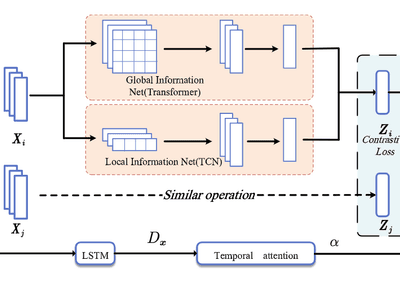
A representation learning framework for stock movement prediction

A representation learning framework for stock movement prediction

ASOC

The learning of high-quality stock representations is one of the keys to predicting stock movements effectively. Current studies have been negatively impacted by stochasticity in stock prices, resulting in inadequate representation learnt by the models. We present an end-to-end stock movement prediction framework (CLSR) utilizing contrastive learning to exploit the correlation between intra-day data and enhance stock representation in order to improve the accuracy of stock movement prediction. In addition, a hybrid encoding network is developed to extract long-range dependencies and local contextual features in stock data, making the feature representation more complete. To further improve the prediction accuracy of the model, historical state information is added to the intra-day stock data. Our experiments on CSI-500 show that the proposed method outperforms state-of-the-art solutions. The proposed method is also validated by analyzing the representation space thoroughly.

† 共同贡献 · * 通讯作者
DOI ↗访问成果 ↗
期刊论文SCI一区 · CCF-B
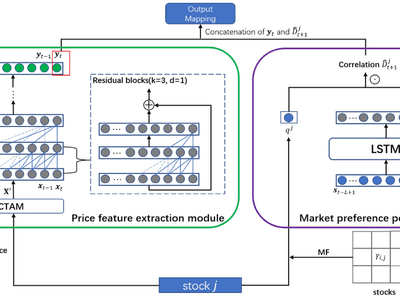
A stock rank prediction method combining industry attributes and price data of stocks

A stock rank prediction method combining industry attributes and price data of stocks

IPM

Stock forecasting has always been challenging as the stock market is affected by a combination of factors. Temporal Convolutional Network (TCN) based on convolutional structure has been widely used in time series prediction in recent years, but the dilated causal convolution structure leaves it unable to effectively learn the dependencies between data at different time points. This paper proposes a method for stock ranking prediction. To enhance the ability of TCN to handle dependencies within series, we first develop a channel-time dual attention module (CTAM). In conjunction with TCN to process complex historical stock price data, CTAM can adaptively learn the importance of multiple price nature series of stocks and model the dependencies between the data at different times. On the other hand, due to the market industry rotation, some stocks with specific industry attributes may become market preference for a period time. To apply the industry attributes to the stock prediction, we construct an industry-stock Pearson correlation matrix and extract a vector that fully characterizes the industry attributes of stocks from it through a matrix factorization algorithm. Furthermore, the historical market preference is modeled according to the industry attribute of the stocks to generate the dynamic correlation between stocks and market preference, and this correlation is combined with the historical price features extracted by TCN for stock ranking prediction. We conduct experiments on three datasets of 950 constituent stocks of the Shanghai Stock Exchange Index, 750 constituent stocks of the Shenzhen Stock Exchange 1000 Index and 486 stocks of the S&P500 to demonstrate the effectiveness of the proposed method. On the Shanghai Stock Exchange Index dataset, the Investment Return Ratio (IRR) obtained by using the predict results of our method to guide the exchange reached 1.416, and the Sharpe Ratio (SR) reached 2.346. On the Shenzhen Stock Exchange Index dataset, the IRR reached 1.434 and the Sharpe ratio reached 2.317. On the S&P500, the IRR reached 1.491 and the Sharpe ratio reached 2.031.

† 共同贡献 · * 通讯作者
DOI ↗访问成果 ↗
期刊论文SCI一区 · CCF-B
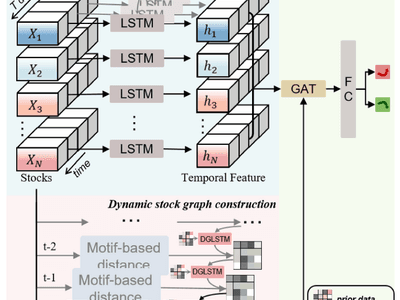
Dynamic graph construction via motif detection for stock prediction

Dynamic graph construction via motif detection for stock prediction

IPM

Stock trend prediction is crucial for recommending high-investment value stocks and can strongly assist investors in making decisions. In recent years, the significance of stock relationships has been gradually recognized for trend prediction, and graph neural networks (GNNs) have been introduced to capture useful features from relationships. However, applying GNNs to stock relationship analysis still faces numerous challenges, including inappropriate distance algorithms, non-dynamic stock graphs, and over-fitting. To address these challenges, we propose a dynamic graph construction module. The module offers the following advantages: (1) A dynamic graph construction module is introduced. (2) A novel stock distance algorithm based on motif detection is proposed to reduce the distance between stocks with similar trends. (3) A dynamic graph-based LSTM is proposed to aggregate the changes in historical graphs. We have conduct numerous experiments on 4503 Chinese A-share stocks, spanning 1218 trading days. Our model demonstrates 8.65% and 1.02% relative improvements in accumulated return and accuracy, respectively. In addition, the trading simulation validates that our algorithm outperforms the state-of-the-art (SOTA) algorithms in terms of profitability.

† 共同贡献 · * 通讯作者
DOI ↗访问成果 ↗
期刊论文SCI一区 · CCF-C
Asset correlation based deep reinforcement learning for the portfolio selection

Asset correlation based deep reinforcement learning for the portfolio selection

ESWA

Portfolio selection is an important application of AI in the financial field, which has attracted considerable attention from academia and industry alike. One of the great challenges in this application is modeling the correlation among assets in the portfolio. However, current studies cannot deal well with this challenge because it is difficult to analyze complex nonlinearity in the correlation. This paper proposes a policy network that models the nonlinear correlation by utilizing the self-attention mechanism to better tackle this issue. In addition, a deterministic policy gradient recurrent reinforcement learning method based on Monte Carlo sampling is constructed with the objective function of cumulative return to train the policy network. In most existing reinforcement learning-based studies, the state transition probability is generally regarded as unknown, so the value function of the policy can only be estimated. Based on financial backtest experiments, we analyze that the state transition probability is known in the portfolio, and value function can be directly obtained by sampling, further theoretically proving the optimality of the proposed reinforcement learning method in the portfolio. Finally, the superiority and generality of our approach are demonstrated through comprehensive experiments on the cryptocurrency dataset, S&P 500 stock dataset, and ETF dataset.

† 共同贡献 · * 通讯作者
DOI ↗访问成果 ↗
期刊论文SCI 3区
LPE-Unet: An Improved UNet Network Based on Perceptual Enhancement

LPE-Unet: An Improved UNet Network Based on Perceptual Enhancement

TVC

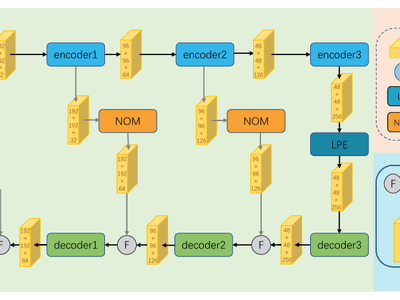
In Computed Tomography (CT) images of the coronary arteries, the segmentation of calcified plaques is extremely important for the examination, diagnosis, and treatment of coronary heart disease. However, one characteristic of the lesion is that it has a small size, which brings two difficulties. One is the class imbalance when computing loss function and the other is that small-scale targets are prone to losing details in the continuous downsampling process, and the blurred boundary makes the segmentation accuracy less satisfactory. Therefore, the segmentation of calcified plaques is a very challenging task. To address the above problems, in this paper, we design a framework named LPE-UNet, which adopts an encoder–decoder structure similar to UNet. The framework includes two powerful modules named the low-rank perception enhancement module and the noise filtering module. The low-rank perception enhancement module extracts multi-scale context features by increasing the receptive field size to aid target detection and then uses an attention mechanism to filter out redundant features. The noise filtering module suppresses noise interference in shallow features to high-level features in the process of multi-scale feature fusion. It computes a pixel-wise weight map of low-level features and filters out useless and harmful information. To alleviate the problem of class imbalance caused by small-sized lesions, we use a weighted cross-entropy loss function and Dice loss to perform mixed supervised training on the network. The proposed method was evaluated on the calcified plaque segmentation dataset, achieving a high F1 score of 0.941, IoU of 0.895, and Dice of 0.944. This result verifies the effectiveness and superiority of our approach for accurately segmenting calcified plaques. As there is currently no authoritative publicly available calcified plaque segmentation dataset, we have constructed a new dataset for coronary artery calcified plaque segmentation (Calcified Plaque Segmentation Dataset, CPS Dataset).

DOI ↗访问成果 ↗
期刊论文SCI一区
Shape-Aware Joint Distribution Alignment for Cross-Domain Image Segmentation

Shape-Aware Joint Distribution Alignment for Cross-Domain Image Segmentation

TMI

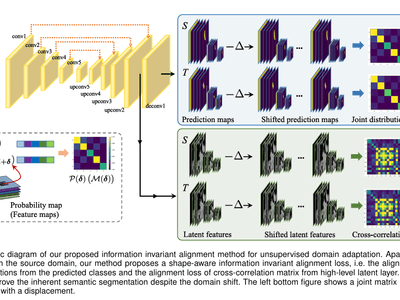
We present an unsupervised domain adaptation method for image segmentation which aligns high-order statistics, computed for the source and target domains, encoding domain-invariant spatial relationships between segmentation classes. Our method first estimates the joint distribution of predictions for pairs of pixels whose relative position corresponds to a given spatial displacement. Domain adaptation is then achieved by aligning the joint distributions of source and target images, computed for a set of displacements. Two enhancements of this method are proposed. The first one uses an efficient multi-scale strategy that enables capturing long-range relationships in the statistics. The second one extends the joint distribution alignment loss to features in intermediate layers of the network by computing their cross-correlation. We test our method on the task of unpaired multi-modal cardiac segmentation using the Multi-Modality Whole Heart Segmentation Challenge dataset and prostate segmentation task where images from two datasets are taken as data in different domains. Our results show the advantages of our method compared to recent approaches for cross-domain image segmentation. Code is available at https://github.com/WangPing521/Domain_adaptation_shape_prior.

† 共同贡献 · * 通讯作者
DOI ↗访问成果 ↗
期刊论文SCI一区
CAT: Constrained Adversarial Training for Anatomically-Plausible Semi-Supervised Segmentation

CAT: Constrained Adversarial Training for Anatomically-Plausible Semi-Supervised Segmentation

TMI

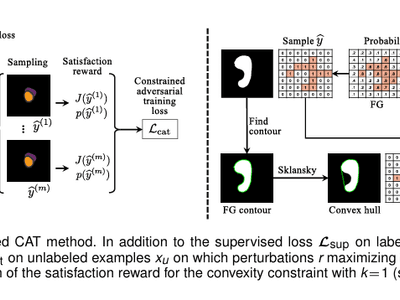
Deep learning models for semi-supervised medical image segmentation have achieved unprecedented performance for a wide range of tasks. Despite their high accuracy, these models may however yield predictions that are considered anatomically impossible by clinicians. Moreover, incorporating complex anatomical constraints into standard deep learning frameworks remains challenging due to their non-differentiable nature. To address these limitations, we propose a Constrained Adversarial Training (CAT) method that learns how to produce anatomically plausible segmentations. Unlike approaches focusing solely on accuracy measures like Dice, our method considers complex anatomical constraints like connectivity, convexity, and symmetry which cannot be easily modeled in a loss function. The problem of non-differentiable constraints is solved using a Reinforce algorithm which enables to obtain a gradient for violated constraints. To generate constraint-violating examples on the fly, and thereby obtain useful gradients, our method adopts an adversarial training strategy which modifies training images to maximize the constraint loss, and then updates the network to be robust to these adversarial examples. The proposed method offers a generic and efficient way to add complex segmentation constraints on top of any segmentation network. Experiments on synthetic data and four clinically-relevant datasets demonstrate the effectiveness of our method in terms of segmentation accuracy and anatomical plausibility.

† 共同贡献 · * 通讯作者
DOI ↗访问成果 ↗

2022

6 项成果
期刊论文SCI一区 · CCF-C
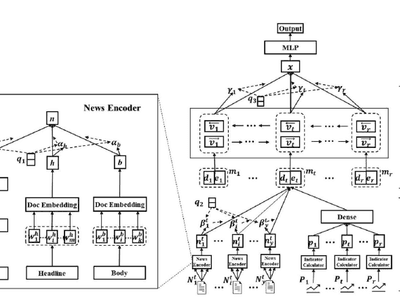
A hierarchical attention network for stock prediction based on attentive multiview news learning

A hierarchical attention network for stock prediction based on attentive multiview news learning

Neurocomputing

Stock prediction with news released on media platform is helpful for investors to make good investment decisions. Recent researches are generally based on single news view, e.g., headline or body, as a predictive indicator and thus information received is insufficient or incomplete which also lacks of study on market information, then bring low performances of models. In this research, we propose a hierarchical attention network based on attentive multi-view news learning (NMNL) to excavate more useful information from news and the stock market for stock prediction. The core of our approach is a news encoder and a market information encoder. In the news encoder, we learn multi-view news information representation from news headlines, bodies and sentiments by regarding them as three independent parts. We find that the combination of headline, body and sentiment outperforms conventional models on single news view. In the market information encoder, we employ the attention mechanism to capture pivotal news information and combine technical indicators to represent representative market information. In addition, a temporal auxiliary based on Bi-directional Long Short-Term Memory (Bi-LSTM) model is used to generate the contextual market information for stock prediction. Extensive experiments demonstrate the superiority of NMNL, which outperforms state-of-the-art stock prediction solutions.

† 共同贡献 · * 通讯作者

DOI ↗访问成果 ↗
期刊论文SCI一区 · CCF-C
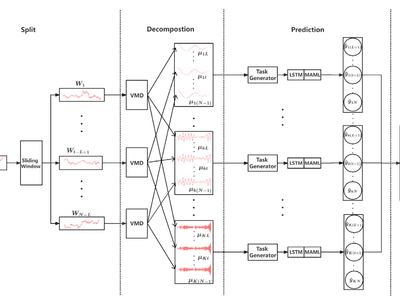
A Stock Price Prediction Method based on Meta-Learning and Variational Mode Decomposition

A Stock Price Prediction Method based on Meta-Learning and Variational Mode Decomposition

KBS

Stock price prediction is an important and challenging research topic, which has wide application prospects. Correct forecasting results can provide valuable guidance to investors and thus reduce the investment risk. To improve the prediction accuracy and obtain better prediction results, a new stock price prediction model called VML is proposed in this paper. First, the VML model slices the stock price series to obtain multiple window series, then uses variational mode decomposition (VMD) to decompose the window series to obtain multiple subseries. Unlike existing decomposition-based methods, VML decomposes the window series to solve the data leakage problem. Next, model-agnostic meta-learning (MAML) algorithm and long short-term memory (LSTM) network are applied to predict the subseries. A method of dividing the decomposed subseries into multiple tasks is proposed for the purpose of utilizing the MAML algorithm to train the initial parameters of the LSTM with good generalization ability. The initial parameters enable LSTM to fine tune dynamically to fit the latest data distribution of stock price data, which mitigates the impact of concept drift on prediction accuracy. Finally, the VML model merges the prediction results of the subseries to obtain the final predicted stock price. Experimental results on stock datasets of the Chinese Stock Market and the American Stock Market demonstrate that the proposed method improves the accuracy of prediction.

† 共同贡献 · * 通讯作者

DOI ↗访问成果 ↗
期刊论文SCI一区 · CCF-B
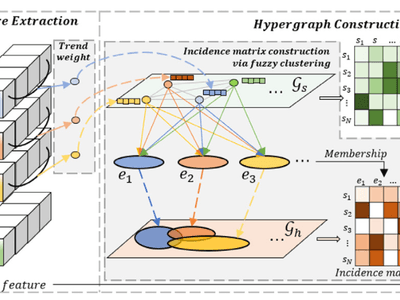
Fuzzy hypergraph network for recommending top-K profitable stocks

Fuzzy hypergraph network for recommending top-K profitable stocks

INS

Stock ranking prediction is an effective method for screening high investment value stocks in the future and can strongly assist investors in making decisions. However, this task is also challenging. In recent years, the role of stock relationship information in ranking prediction has been gradually recognized, and the hypergraph has been introduced to analyze the complex group-wise relationships between stocks. However, the application of hypergraph to stock relationship analysis still faces two major issues: unreasonable hyperedge construction and inappropriate aggregation operation in graph convolution that does not conform to the actual market. To solve these problems, we propose an attribute-driven fuzzy hypergraph network (AFHGN). Compared to the traditional hypergraph, AFHGN provides the following advantages: (1) The incidence matrix is constructed via fuzzy clustering to describe the relationships between stocks more reasonably. (2) An attribute-driven gate unit is introduced in the graph convolution to simulate the influence of stocks in the real market. (3) Trend weights are created to enhance the ability of stock embeddings to represent trends. The effectiveness of our algorithm has been verified by conducting a large number of experiments on real data. In addition, the investment simulation proves that our algorithm has better profitability than the state-of-the-art (SOTA) algorithms.

† 共同贡献 · * 通讯作者

DOI ↗访问成果 ↗
期刊论文SCI 4区 · CCF C类
An Efficient FCM-Based Method for Image Refinement Segmentation

An Efficient FCM-Based Method for Image Refinement Segmentation

The Visual Computer

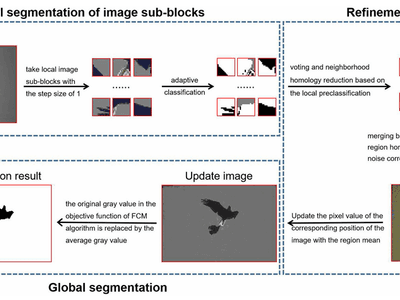
The conventional fuzzy c-means clustering (FCM) algorithm is sensitive to noise because no spatial information is taken into account. Many related algorithms reduce the influence of noise by adding local information to the objective function. However, there are still many problems, such as poor edge-preserving and anti-noise performance. This paper proposes an FCM-based method for image refinement segmentation to address the above problems effectively. We first take advantage of the pre-classification results of image sub-blocks as a new metric to measure the similarity of pixels and then combine the grayscale and spatial features of the local windows to vote and refine on these initial clustering results, which optimize the classification of pixels. Compared with existing algorithms, our algorithm can correct the misclassified pixels in the global segmentation and reserve image edge better. In addition, it is efficient for noisy image segmentation, which can maximize the recognition of noise and eliminate outliers. Experiments on both synthetic images and real-world images demonstrate the effectiveness and accuracy of the proposed method.

DOI ↗访问成果 ↗
期刊论文SCI一区 · CCF-B

High quality superpixel generation through regional decomposition

IEEE TCSVT

Superpixel generation is increasingly an important area for computer vision tasks. While superpixels with highly regular shapes are preferred to make the subsequent processing easier, the accuracy of the superpixel boundaries is also necessary. Previous methods usually depend on a distance function considering both spatial and color coherency regularization on the whole image, which however is hard to balance between shape regularity and boundary adherence, especially when the desired number of superpixels is small. In addition, non-adaptive parameters and insufficient contour information also affect the performance of segmentation. To mitigate these problems, we propose a robust divide-and-conquer superpixel segmentation method, of which the core idea is that we apply a new contour information extraction and a pixel clustering to separate the input image into flat and non-flat regions, where the former targets shape regularity and the latter emphasizes boundary adherence, followed by an efficient hierarchical merging to clean up tiny and dangling superpixels. Our algorithm requires no additional parameter tuning except the desired number of superpixels since our internal parameters are self-adaptive to the image contents. Experimental results demonstrate that for public benchmark datasets, our algorithm consistently generates more regular superpixels with stronger boundary adherence than state-of-the-art methods while maintaining a competitive efficiency. The source code is available at https://github.com/YunyangXu/HQSGRD.

† 共同贡献 · * 通讯作者

DOI ↗访问成果 ↗
期刊论文SCI一区
Restricted Delaunay Triangulation for Explicit Surface Reconstruction

Restricted Delaunay Triangulation for Explicit Surface Reconstruction

ACM Trans. Graphics

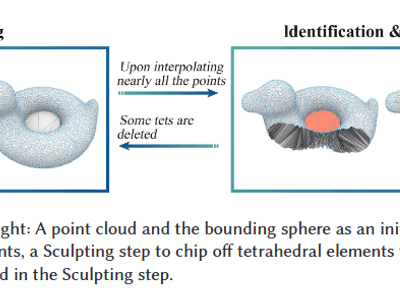
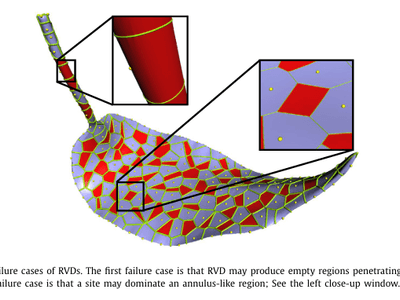
The task of explicit surface reconstruction is to generate a surface mesh by interpolating a given point cloud. Explicit surface reconstruction is necessary when the point cloud is required to appear exactly on the surface. However, for a non-perfect input, such as lack of normals, low density, irregular distribution, thin and tiny parts, and high genus, a robust explicit reconstruction method that can generate a high-quality manifold triangulation is missing. We propose a robust explicit surface reconstruction method that starts from an initial simple surface mesh, alternately performs a Filmsticking step and a Sculpting step of the initial mesh, and converges when the surface mesh interpolates all input points (except outliers) and remains stable. The Filmsticking is to minimize the geometric distance between the surface mesh and the point cloud through iteratively performing a restricted Voronoi diagram technique on the surface mesh, whereas the Sculpting is to bootstrap the Filmsticking iteration from local minima by applying appropriate geometric and topological changes of the surface mesh. Our algorithm is fully automatic and produces high-quality surface meshes for non-perfect inputs that are typically considered to be challenging for prior state of the art. We conducted extensive experiments on simulated scans and real scans to validate the effectiveness of our approach.

† 共同贡献 · * 通讯作者

DOI ↗访问成果 ↗

2021

2 项成果
期刊论文SCI 3区 · CCF C类
Image Smoothing Based on Global Sparsity Decomposition and a Variable Parameter

Image Smoothing Based on Global Sparsity Decomposition and a Variable Parameter

CVM

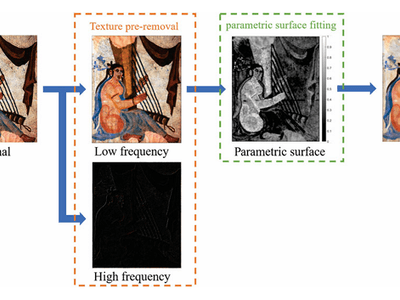
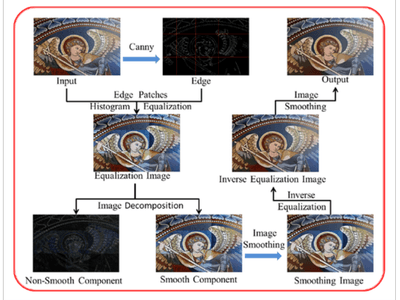
Smoothing images, especially with rich texture, is an important problem in computer vision. Obtaining an ideal result is difficult due to complexity, irregularity, and anisotropicity of the texture. Besides, some properties are shared by the texture and the structure in an image. It is a hard compromise to retain structure and simultaneously remove texture. To create an ideal algorithm for image smoothing, we face three problems. For images with rich textures, the smoothing effect should be enhanced. We should overcome inconsistency of smoothing results in different parts of the image. It is necessary to create a method to evaluate the smoothing effect. We apply texture pre-removal based on global sparse decomposition with a variable smoothing parameter to solve the first two problems. A parametric surface constructed by an improved Bessel method is used to determine the smoothing parameter. Three evaluation measures: edge integrity rate, texture removal rate, and gradient value distribution are proposed to cope with the third problem. We use the alternating direction method of multipliers to complete the whole algorithm and obtain the results. Experiments show that our algorithm is better than existing algorithms both visually and quantitatively. We also demonstrate our method’s ability in other applications such as clip-art compression artifact removal and content-aware image manipulation.

DOI ↗访问成果 ↗
期刊论文CCF-B
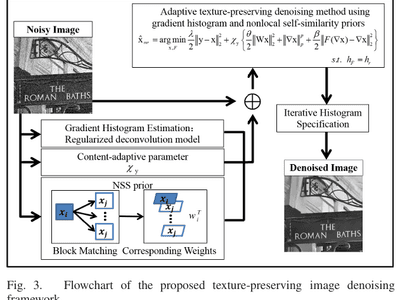
Detail preserving image denoising with patch-based structure similarity via sparse representation and SVD

Detail preserving image denoising with patch-based structure similarity via sparse representation and SVD

CVIU

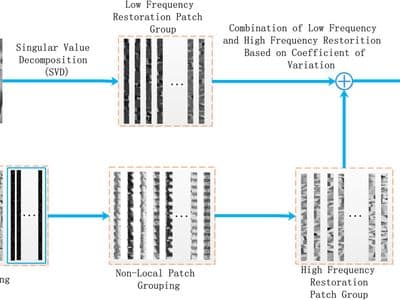
The key problem of image denoising methods is to smooth noise while retaining the details of original image. The human vision system is more sensitive to the details (or the high frequency components) of original image, hence the restoration of image details ensures the good quality of denoised image. Different from denoising the image as a whole, this paper proposes a novel denoising method that reconstructs the high and low frequency components respectively. The sparse representation using patch-based structure similarity is proposed to reconstruct the high frequency parts. And the low frequency parts are reconstructed by singular value decomposition (SVD). Finally an energy minimization function that contains high and low frequency parts are presented. Experimental results illustrate that the proposed method is outstanding in both numerical precision and visual performance.

† 共同贡献 · * 通讯作者

DOI ↗访问成果 ↗

2020

5 项成果
期刊论文SCI 4区 · CCF C类
Single-Image Super-Resolution Based on Local Biquadratic Spline with Edge Constraints and Adaptive Optimization in Transform Domain

Single-Image Super-Resolution Based on Local Biquadratic Spline with Edge Constraints and Adaptive Optimization in Transform Domain

The Visual Computer

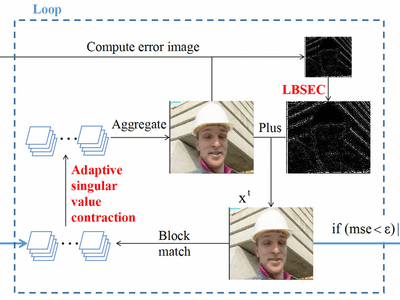
This paper proposes a novel single-image super-resolution method based on local biquadratic spline with edge constraints and adaptive optimization in transform domain. The complex internal structure of the image makes the values of adjacent pixels often differ greatly. Using surface patches to interpolate image blocks can avoid large surface oscillation. Because the quadratic spline has better shape-preserving property, we construct the biquadratic spline surface on each image block to make the interpolation more flexible. The boundary conditions have great influence on the shape of local biquadratic spline surfaces and are the keys to constructing surfaces. Using edge information as a constraint to calculate them can reduce jagged and mosaic effects. To decrease the errors caused by surface fitting, we propose a new adaptive optimization model in transform domain. Compared with the traditional iterative back-projection, this model further improves the magnification accuracy by introducing SVD-based adaptive optimization. In the optimization, we convert similar block matrices to the transform domain by SVD. Then the contraction coefficients are calculated according to the non-local self-similarity, and the singular values are contracted. Experimental comparison with the other state-of-the-art methods shows that the proposed method has better performance in both visual effect and quantitative measurement.

DOI ↗访问成果 ↗
期刊论文SCI 3区 · CCF C类
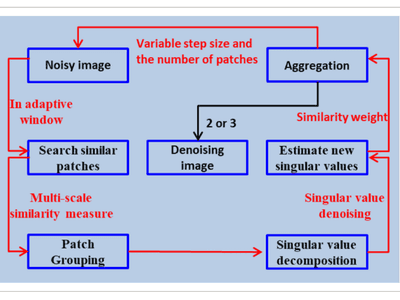
Adaptive iterative global image denoising method based on SVD

Adaptive iterative global image denoising method based on SVD

IET Image Processing

Based on the image self-similarity and singular value decomposition (SVD) techniques, the authors propose an iterative adaptive global denoising method. For the structural differences between image patches, they adaptively determine the size of the search window. In each window, a similar image patch matrix is constructed based on the multi-scale similarity measure. In order to ensure the speed of the method, the adaptive step size and the number of image patches are introduced, and all image patches are denoised in different iterations. This not only ensures the speed of the method, suppresses residual noise, but also reduces the artefacts caused by the fixed step size and the number of image patches. Therefore, the problem of image denoising is converted to the estimation of low-rank matrix. New singular values are estimated according to the noise level, and similar image patch matrices without noise are estimated using them and corresponding singular vectors. Experimental results show that compared with the state-of-the-art denoising algorithms, this method has a higher PSNR and FSIM, and has a good visual effect. The new method can be applied to image and video restoration, target recognition and image classification.

DOI ↗访问成果 ↗
期刊论文SCI 2区
A Medical Image Segmentation Method with Anti-noise and Bias-field Correction

A Medical Image Segmentation Method with Anti-noise and Bias-field Correction

IEEE Access

Brain magnetic resonance images (MRI) are affected by noise and bias field, which make the traditional FCM algorithm unable to segment tissue regions of MR images accurately. Based on the above problems, this paper proposes an MR image segmentation method (MPCFCM) with anti-noise and bias field correction, which implements segmentation by point-to-plane algebraic distance constraint. Different from traditional point-based clustering methods, a hyper-center of clustering (i.e., plane) model is defined, and data clustering is completed by optimizing different planes. In addition, to realize the point clustering with plane, a key problem that how to measure the distance from point to plane needs to be solved. This paper adopts the algebraic distance as a measure function, which can avoid the nonlinear problem caused by a direct calculation of the minimum distance between a point and a plane, thus simplifying the computational complexity. In the proposed algorithm, spatial distance, local variance and gray-difference of neighbors are combined to construct a new anti-noise smoothing factor for constraining the energy function so that the algorithm has better anti-noise and retains more image details. Finally, the singular value decomposition is performed on the loss energy, some information removed is re-added to the segmented image to repair it. The experimental results show that MPCFCM algorithm can better correct bias field and eliminate noise and obtain accurate image segmentation results with more details.

DOI ↗访问成果 ↗
期刊论文SCI 3区 · CCF C类
Two-stage Image Smoothing Based on Edge-patch Histogram Equalization and Patch Decomposition

Two-stage Image Smoothing Based on Edge-patch Histogram Equalization and Patch Decomposition

IET Image Processing

Part of important structural edges in the image is smoothed due to the small gradients, while the others are preserved with greater gradients. Therefore, the authors propose a two-stage image smoothing method based on edge-patch histogram equalisation and patch decomposition. The authors' purpose is to increase the gradient of important structural edges while reducing the gradient of the texture region. Therefore, they divide the image into edge-patches where the structural edges are concentrated or non-edge-patches where the texture details are concentrated by image segmentation. The edge-patch needs to be equalised by the histograms for increasing the gradient of the edge pixels. All patches are decomposed to extract the smooth component for reducing the gradient of pixels. The smooth component of each patch is smoothed via urn:x-wiley:17519659:media:ipr2bf02323:ipr2bf02323-math-0001 gradient minimisation. In order to ensure the continuity of the patch boundaries, the edge-patch is inversely equalised. Finally, the whole image is smoothed via urn:x-wiley:17519659:media:ipr2bf02323:ipr2bf02323-math-0002 gradient minimisation for removing residual textures and seams. Experimental results demonstrate that the proposed method is more competitive in maintaining important structural edges and removing texture details than the state-of-the-art approaches. The proposed method can be applied to many areas of image processing.

DOI ↗访问成果 ↗
期刊论文SCI二区
Robustly computing restricted Voronoi diagrams (RVD) on thin-plate models

Robustly computing restricted Voronoi diagrams (RVD) on thin-plate models

CAD

Voronoi diagram based partitioning of a 2-manifold surface in is a fundamental operation in the field of geometry processing. However, when the input object is a thin-plate model or contains thin branches, the traditional restricted Voronoi diagrams (RVD) cannot induce a manifold structure that is conformal to the original surface. Yan et al. (2014) are the first who proposed a localized RVD (LRVD) algorithm to handle this issue. Their algorithm is based on a face-level clustering technique, followed by a sequence of bisector clipping operations. It may fail when the input model has long and thin triangles. In this paper, we propose a more elegant/robust algorithm for computing RVDs on models with thin plates or even tubular parts. Our idea is inspired by such a fact: the desired RVD must guarantee that each site dominates a single region that is topologically identical to a disk. Therefore, when a site dominates disconnected subregions, we identify those ownerless regions and re-partition them to the nearby sites using a simple and fast local Voronoi partitioning operation. For each site that dominates a tubular part, we suggest add two more sites such that the three sites are almost rotational symmetric. Our approach is easy to implement and more robust to challenging cases than the state-of-the-art approach.

† 共同贡献 · * 通讯作者

DOI ↗访问成果 ↗

2019

3 项成果
期刊论文SCI二区
Multi-strip smooth developable surfaces from sparse design curves

Multi-strip smooth developable surfaces from sparse design curves

CAD

Creating developable surfaces from sparse design curves finds important applications in industrial design and modeling. Existing methods aim at finding a quasi-developable surface with as large developability as possible to interpolate design curves. Even so, the fabrication of industrial products with inextensible materials puts a higher request for surface developability. We propose a method to explore the space of developable surfaces whose boundaries are restricted in the close neighborhood of input design curves and aim at obtaining a smooth surface of a high degree of developability bounded by smooth curves perturbed from input curves. This is achieved by computing a developable surface with approximate boundaries, which is obtained by solving a geometric optimization problem. The performance of the proposed method is demonstrated by a number of experiments of design and fabrication of some industrial products with paper.

† 共同贡献 · * 通讯作者

DOI ↗访问成果 ↗
期刊论文CCF C类
Weighted Superpixel Segmentation

Weighted Superpixel Segmentation

The Visual Computer

Image boundaries and regularity are two important factors in superpixel segmentation. Balancing the influence of image boundaries and regularity is key to producing superpixels. In this paper, we present a novel superpixel segmentation algorithm, called weighted superpixel segmentation (WSS), which is capable of generating superpixels with high boundary adherence and regular shape in a linear time. In WSS, superpixels are generated according to a distance metric defined by the combination of a weight function term, color distance term and plane distance term. Unlike other superpixel algorithms, the weight function is calculated for each pixel to determine the weight of the color distance term and plane distance term in the distance metric. To increase superpixel regularity, superpixel seeds are initialized in a hexagonal manner. Then, we use the distance metric to obtain the initial superpixels. Determining the seed search range is an essential factor to improve algorithm accuracy; thus, a dynamic circle search range is designed in our algorithm that can provide better superpixel results. Finally, a merging strategy is applied to obtain the final superpixels and ensure that the number of superpixels agrees with expectations. Experimental results demonstrate that WSS performs as well as or even better than the existing methods in terms of several commonly used evaluation metrics in superpixel segmentation.

DOI ↗访问成果 ↗
期刊论文SCI一区
Sketch simplification guided by complex agglomeration

Sketch simplification guided by complex agglomeration

SSI

We propose a novel method for vector sketch simplification based on the simplification of the geometric structure that is extracted from the input vector graph, which can be referred to as a base complex. Unlike the sets of strokes, which are treated in the existing approaches, a base complex is considered to be a collection of various geometric primitives. Guided by the shape similarity metrics that are defined for the base complex, an agglomeration procedure is proposed to simplify the base complex by iteratively merging a pair of geometric primitives that exhibit the minimum cost into a new one. This simplified base complex is finally converted into a simplified vector graph. Our algorithm is computationally efficient and is able to retain a large amount of useful shape information from the original vector graph, thereby achieving a tradeoff between efficiency and geometric fidelity. Furthermore, the level of simplification of the input vector graph can be easily controlled using a single threshold in our method. We make comparisons with some existing methods using the datasets that have been provided in the corresponding studies as well as using different styles of sketches drawn by artists. Thus, our experiments demonstrate the computational efficiency of our method and its capability for producing the desirable results.

† 共同贡献 · * 通讯作者

DOI ↗访问成果 ↗

2018

2 项成果
期刊论文CCF B类
Image Smoothing Based on Image Decomposition and Sparse High Frequency Gradient

Image Smoothing Based on Image Decomposition and Sparse High Frequency Gradient

Journal of Computer Science and Technology

Image smoothing is a crucial image processing topic and has wide applications. For images with rich texture, most of the existing image smoothing methods are difficult to obtain significant texture removal performance because texture containing obvious edges and large gradient changes is easy to be preserved as the main edges. In this paper, we propose a novel framework (DSHFG) for image smoothing combined with the constraint of sparse high frequency gradient for texture images. First, we decompose the image into two components: a smooth component (constant component) and a non-smooth (high frequency) component. Second, we remove the non-smooth component containing high frequency gradient and smooth the other component combining with the constraint of sparse high frequency gradient. Experimental results demonstrate the proposed method is more competitive on efficiently texture removing than the state-of-the-art methods. What is more, our approach has a variety of applications including edge detection, detail magnification, image abstraction, and image composition.

DOI ↗访问成果 ↗
期刊论文SCI一区
Adaptive Texture-Preserving Denoising Method Using Gradient Histogram and Nonlocal Self-Similarity Priors

Adaptive Texture-Preserving Denoising Method Using Gradient Histogram and Nonlocal Self-Similarity Priors

TCSVT

Natural image priors play an important role in image denoising, and various prior-based methods have been widely proposed for noise removal. However, these methods tend to smooth the fine image textures while suppressing noise, degrading the image visual quality. To address this problem, in this paper, we propose an adaptive texture-preserving denoising method. In contrast to most existing prior-based denoising methods, two types of priors [gradient histogram matching priors and nonlocal self-similarity (NSS) priors] are proposed, and their combination is used for image denoising. We introduce a hyper-Laplacian distribution of the gradient histogram matching prior, which enforces the gradient histogram of the denoised image to be as close as possible to the estimated reference histogram from the original image. Meanwhile, the proposed model obtained by introducing the NSS priors effectively preserves fine image details and generates sharp image edges. To improve the accuracy of the method, a content-adaptive parameter selection scheme based on edge detection filters is proposed. Moreover, the optimization problem with two types of priors and the content-adaptive parameter added into the objective function becomes a challenging non-convex optimization problem. To effectively solve this problem, we have developed a new numerical solution based on augmented Lagrangian multipliers and alternating minimization scheme. The experimental results demonstrate that the proposed method effectively preserves the texture features of the denoised images and outperforms several variational methods and other state-of-the-art methods in terms of various evaluation indices and visual quality, especially at medium and high noise levels.

† 共同贡献 · * 通讯作者

DOI ↗访问成果 ↗

2017

1 项成果
期刊论文SCI一区
Formula for computing knots with minimum stress and stretching energies

Formula for computing knots with minimum stress and stretching energies

SSI

Computing knots for a given set of data points in a plane is one of the key steps in the construction of fitting curves with high precision. In this study, a new method is proposed for computing a parameter value (knot) for each data point. With only three adjacent consecutive data points, one may not determine a unique interpolation quadratic polynomial curve, which has one degree of freedom (a variable). To obtain a better curve, the stress and stretching energies are used to optimize this variable so that the quadratic polynomial curve has required properties, which ensure that when the three consecutive points are co-linear, the optimal quadratic polynomial curve constructed is the best. If the position of the mid-point of the three points lies between the first point and the third point, the quadratic polynomial curve becomes a linear polynomial curve. Minimizing the stress and stretching energies is a time-consuming task. To avoid the computation of energy minimization, a new model for simplifying the stress and stretching energies is presented. The new model is an explicit function and is used to compute the knots directly, which greatly reduces the amount of computation. The knots are computed by the new method with minimum stress and stretching energies in the sense that if the knots computed by the new method are used to construct quadratic polynomial, the quadratic polynomial constructed has the minimum stress and stretching energies. Experiments show that the curves constructed using the knots generated by the proposed method result in better interpolation precision than the curves constructed using the knots by the existing methods.

† 共同贡献 · * 通讯作者

DOI ↗访问成果 ↗

2016

4 项成果
期刊论文SCI二区
Construction of G3 conic spline interpolation

Construction of G3 conic spline interpolation

CAD

In this paper, a new method to interpolate a sequence of ordered points with conic splines is presented. The degree of continuity at the joints of the resulting splines can reach G3; and the splines are faired by decreasing curvature extrema. The construction is not based on parametrization, but based on basic geometric elements, such as the directions of tangents and chord lengths. The weight of Rational Quadratic Bézier Spline is translated into an equivalent form called chord–tangent ratio. The main idea of the new method is converting the geometric construction problem into a conditional extrema problem through representing the curvature and the curvature changing rate at joints with tangent arguments and chord–tangent ratios, and then deriving the unknowns by solving the conditional extremum problem. Experiments show that splines constructed by the new method perform well not only in terms of continuity, but also in smoothness.

† 共同贡献 · * 通讯作者

DOI ↗访问成果 ↗
期刊论文CCF-A
特征约束的多实例图像超分辨率

特征约束的多实例图像超分辨率

JCAD

基于实例的图像超分辨率方法通过已知实例图像学习高低分辨率图像之间的关系模型, 利用该模型预测未知高分辨率图像信息, 具有较好的放大效果, 但需要庞大的外部图像库. 为此, 提出一种特征约束的多实例图像超分辨率方法. 首先提出特征约束多项式插值方法初始化高分辨率低频图像; 其次以高、低分辨率图像的低频图像作为已知实例对, 在低分辨率低频图像中, 对高分辨率低频图像块采用自适应 KNN 搜索算法搜索相似图像块并得出回归关系模型; 最后将该模型应用到低分辨率高频图像获取初始高分辨率图像所缺失的高频信息. 大量实验结果表明, 该方法产生的高分辨率图像可以较好地保持图像特征, 具有较高的 PSNR 值及 SSIM 值.

† 共同贡献 · * 通讯作者

DOI ↗访问成果 ↗
期刊论文CCF-B

A modied fuzzy c-means algorithm for brain MR image segmentation and bias field correction

JCST

In quantitative brain image analysis, accurate brain tissue segmentation from brain magnetic resonance image (MRI) is a critical step. It is considered to be the most important and difficult issue in the field of medical image processing. The quality of MR images is influenced by partial volume effect, noise, and intensity inhomogeneity, which render the segmentation task extremely challenging. We present a novel fuzzy c-means algorithm (RCLFCM) for segmentation and bias field correction of brain MR images. We employ a new gray-difference coefficient and design a new impact factor to measure the effect of neighbor pixels, so that the robustness of anti-noise can be enhanced. Moreover, we redefine the objective function of FCM (fuzzy c-means) by adding the bias field estimation model to overcome the intensity inhomogeneity in the image and segment the brain MR images simultaneously. We also construct a new spatial function by combining pixel gray value dissimilarity with its membership, and make full use of the space information between pixels to update the membership. Compared with other state-of-the-art approaches by using similarity accuracy on synthetic MR images with different levels of noise and intensity inhomogeneity, the proposed algorithm generates the results with high accuracy and robustness to noise.

† 共同贡献 · * 通讯作者

DOI ↗访问成果 ↗
期刊论文

Image interpolation algorithm on a triangular grid

CADDM

A new method for constructing a fitting surface on a triangular grid is presented.Assuming images are obtained by sampling from the original scene.Conventional polynomial interpolation methods generally construct the fitting surface on a square grid.Different from existing methods,the new method constructs the fitting surface on a triangular grid which can divide the original surface more detailed and improve approximation accuracy.As the quality of the image edges plays a key role in visual effects of image,the new method uses image edges as constraints to get a triangle grid.The new method constructs a cubic polynomial patch locally using image data to approximate the original surface.Experimental comparison results of the new method with other methods show that the new method can produce high-quality images and remove the zigzagging artifact.

† 共同贡献 · * 通讯作者

DOI ↗访问成果 ↗

2015

2 项成果
期刊论文

A fast and robust FCM algorithm with local information for image segmentation

ICIC Express Letters

We propose a novel fast and robust FCM framework for image segmentation. It relies on a finer partitioning of the original image into regular superpixels of uniform gray values. The algorithm uses superpixels as the basic unit of segmentation instead of pixel, and also includes local spatial and gray information to enhance the noise immunity. The experiments on the synthetic and MR images show that the proposed algorithm is effective and efficient.

† 共同贡献 · * 通讯作者

访问成果 ↗
期刊论文CCF-C

Salt and pepper noise removal in surveillance video based on low-rank matrix recovery

CVM

This paper proposes a new algorithm based on low-rank matrix recovery to remove salt & pepper noise from surveillance video. Unlike single image denoising techniques, noise removal from video sequences aims to utilize both temporal and spatial information. By grouping neighboring frames based on similarities of the whole images in the temporal domain, we formulate the problem of removing salt & pepper noise from a video tracking sequence as a low-rank matrix recovery problem. The resulting nuclear norm and L1-norm related minimization problems can be efficiently solved by many recently developed methods. To determine the low-rank matrix, we use an averaging method based on other similar images. Our method can not only remove noise but also preserve edges and details. The performance of our proposed approach compares favorably to that of existing algorithms and gives better PSNR and SSIM results.

† 共同贡献 · * 通讯作者

DOI ↗访问成果 ↗

2014

2 项成果
期刊论文SCI四区

Discussion on relationship between minimal energy and curve shapes

APPL MATH SER B

Energy minimization has been widely used for constructing curve and surface in the fields such as computer-aided geometric design, computer graphics. However, our testing examples show that energy minimization does not optimize the shape of the curve sometimes. This paper studies the relationship between minimizing strain energy and curve shapes, the study is carried out by constructing a cubic Hermite curve with satisfactory shape. The cubic Hermite curve interpolates the positions and tangent vectors of two given endpoints. Computer simulation technique has become one of the methods of scientific discovery, the study process is carried out by numerical computation and computer simulation technique. Our result shows that: (1) cubic Hermite curves cannot be constructed by solely minimizing the strain energy; (2) by adoption of a local minimum value of the strain energy, the shapes of cubic Hermite curves could be determined for about 60 percent of all cases, some of which have unsatisfactory shapes,however. Based on strain energy model and analysis, a new model is presented for constructing cubic Hermite curves with satisfactory shapes, which is a modification of strain energy model. The new model uses an explicit formula to compute the magnitudes of the two tangent vectors, and has the properties: (1) it is easy to compute; (2) it makes the cubic Hermite curves have satisfactory shapes while holding the good property of minimizing strain energy for some cases in curve construction. The comparison of the new model with the minimum strain energy model is included.

† 共同贡献 · * 通讯作者

DOI ↗访问成果 ↗
期刊论文

Non-homogeneous mesh resizing with feature preserved

JICS

Model resizing is very useful when creating new models based on existing ones or applying models in different scenes. In order to determine the features to be preserved, recent resizing techniques have focused on mesh analysis to get low-level characteristics like edge and face vulnerability to scale, or high-level characteristics like mesh symmetry and parallelism. We observe that the extraction of such mesh information is time-consuming and very limited, so we let the user choose the features to be maintained, and provide the user with a flexible selection mode based on a simple mesh segmentation. Our method can precisely preserve the user-specified features and maintain its boundary continuity, meeting the requirements of engineering applications. The method resizes the model by a spacedeformation technique, so it can handle complex models with multiple connected components and intertwined features. A number of experimental results have shown that our approach has obtained pleasing results and outperformed the previous approaches.

† 共同贡献 · * 通讯作者

DOI ↗访问成果 ↗

2013

2 项成果
期刊论文SCI二区
Local computation of curve interpolation knots with quadratic precision

Local computation of curve interpolation knots with quadratic precision

CAD

There are several prevailing methods for selecting knots for curve interpolation. A desirable criterion for knot selection is whether the knots can assist an interpolation scheme to achieve the reproduction of polynomial curves of certain degree if the data points to be interpolated are taken from such a curve. For example, if the data points are sampled from an underlying quadratic polynomial curve, one would wish to have the knots selected such that the resulting interpolation curve reproduces the underlying quadratic curve; in this case, the knot selection scheme is said to have quadratic precision. In this paper, we propose a local method for determining knots with quadratic precision. This method improves on our previous method that entails the solution of a global equation to produce a knot sequence with quadratic precision. We show that this new knot selection scheme results in better interpolation error than other existing methods, including the chord-length method, the centripetal method and Foley’s method, which do not possess quadratic precision.

† 共同贡献 · * 通讯作者

DOI ↗访问成果 ↗
期刊论文CCF-A

纹理无关的轮胎裂纹检测算法

JCAD

根据从图像中提取的裂纹缺陷特征,提出一种基于线密度投影(PODOL)的轮胎裂纹缺陷检测方法.首先对轮胎图像进行线密度投影,得到它们的PODOL一阶导数绝对值曲线;然后提取裂纹图像的特征曲线,以这些特征曲线作为标准判定轮胎是否含有裂纹.实验结果表明,文中提出的特征曲线检测标准不受图像纹理的影响,可以高效地检测轮胎裂纹缺陷;且该方法速度快、实现简单,已经成功用于轮胎裂纹缺陷的实时在线检测.

† 共同贡献 · * 通讯作者

DOI ↗访问成果 ↗

2012

2 项成果
期刊论文SCI二区

Graph cuts image segmentation in a hexagonal-image processing framework

JCIS

Graph Cuts as an advanced image segmentation method has been widely used in many applications. It is implemented in a hexagonal-image processing framework firstly in this paper. The new method is called hexagonal Graph Cuts. The core of the method is based on a novel hexagon-based sampling method, which is according to area measurement. The new sampling method can improve the conversion quality from square pixels to hexagonal pixels obviously. When the classic Graph Cuts algorithm is implemented on a hexagonal-image, the boundary penalties of adjacent pixels can be better assessed. Experiments showed that the proposed method significantly improved the segmentation results, especially for the segmentation quality in the border region.

† 共同贡献 · * 通讯作者

访问成果 ↗
期刊论文

Color homogenization of the color cryosection images based on color transfer

RASET

Color inhomogeneity is a known issue in serial cryosections, but there has not been a simple and effective method to solve this problem yet. A new method is proposed to reduce color inhomogeneities in this study, which is based on color transfer technique. It takes advantage of the similarity of adjacent images in image series. The new method can unify the color styles of adjacent slices to achieve the color homogenization of the image series. The color correction process of our method only needs the calculation of mean and standard deviation of pixels of the image. So the new method is simple and highly-efficient. By the multiplanar reformation images, the experimental result shows that the new method has a good performance.

† 共同贡献 · * 通讯作者

DOI ↗访问成果 ↗

2011

1 项成果
期刊论文SCI一区

基于组合方法对图像的双三次多项式拟合

SSI

提出了基于图像数据构造拟合曲面的新方法.假设给定的图像数据所对应的原场景曲面能用分片二次多项式曲面表示,原场景曲面称为原曲面.现有方法通常是用图像数据作为插值数据构造原曲面的拟合曲面,而新方法以图像数据生成公式为约束,通过反向采样过程来构造对图像数据拟合的曲面,从而使拟合曲面具有更好的逼近精度.由于图像边缘处的质量对图像的视觉效果起着关键的作用,我们也把图像边缘做为约束条件用于拟合曲面的构造.对于每一个数据点及其邻近区域,新方法以采样公式和图像边缘作为约束条件局部地构造一张二次多项式曲面片,该曲面片具有二次多项式精度.所有的二次多项式曲面片的加权组合形成逼近原曲面的拟合曲面.对算法比较的实验表明,由新方法生成的放大图像具有较高的精度和较好的视觉效果.

† 共同贡献 · * 通讯作者

DOI ↗访问成果 ↗

2010

5 项成果
期刊论文SCI一区

Cubic Surface Fitting to Image by Combination

SSI

We present a new method for constructing a fitting surface to image data. The new method is based on a supposition that the given image data are sampled from an original scene that can be represented by a surface defined by piecewise quadratic polynomials. The surface representing the original scene is known as the original surface in this paper. Unlike existing methods, which generally construct the fitting surface to the original surface using image data as interpolation data, the new method constructs the fitting surface using the image data as constraints to reverse the sampling process, which improves the approximation precision of the fitting surface. Associated with each data point and its near region, the new method constructs a quadratic polynomial patch locally using the sampling formula as constraint. The quadratic patch approximates the original surface with a quadratic polynomial precision. The fitting surface which approximates the original surface is formed by the combination of all the quadratic polynomial patches. The experiments demonstrate that compared with Bi-cubic and Separable PCC methods, the new method produced resized images with high precision and good quality.

† 共同贡献 · * 通讯作者

DOI ↗访问成果 ↗
会议论文

Enlarging Image with bilinear polynomial precision

ITIP2020

a new method for enlarging images is presented. The new method is based on a supposition that the elements of the image are sampled from an original surface that can be expressed piecewise by bilinear polynomial functions. Each element of the image is divided into four sub-elements with a bilinear polynomial precision as a constraint, so the image is enlarged by 2 times. The image is enlarged with a local way. The experiments for testing the efficiency of the new method showed that the enlarged images produced by the new method have high precision and good quality.

† 共同贡献 · * 通讯作者

访问成果 ↗
期刊论文

Selecting knots locally for curve interpolation with quadratic precision

LNCS

There are several prevailing methods for selecting knots for curve interpolation. A desirable criterion for knot selection is whether the knots can assist an interpolation scheme to achieve the reproduction of polynomial curves of certain degree if the data points to be interpolated are taken from such a curve. For example, if the data points are sampled from an underlying quadratic polynomial curve, one would wish to have the knots selected such that the resulting interpolation curve reproduces the underlying quadratic curve; and in this case the knot selection scheme is said to have quadratic precision. In this paper we propose a local method for determining knots with quadratic precision. This method improves on upon our previous method that entails the solution of a global equation to produce a knot sequence with quadratic precision. We show that this new knot selection scheme results in better interpolation error than other existing methods, including the chord-length method, the centripetal method and Foley's method, which do not possess quadratic precision.

DOI ↗访问成果 ↗
期刊论文

Active contour method combining local fitting energy and global fitting energy dynamically

LNCS

To get better segmentation results, local information and global information should be taken into consideration together. In this paper, we propose a new energy functional which combines a local intensity fitting term and an auxiliary global intensity fitting term, and we also give the method to adjust the weight of auxiliary global fitting term dynamically by using local contrast of the image. The combination of the two terms improves the accuracy of segmentation results obviously while reduces dependence on location of initial contour. The experiment results proved the effectiveness of our method.

DOI ↗访问成果 ↗
期刊论文

Image Interpolation via Combining Patches based on Point-sampling and new Edge-directed Ideas

CISP

This paper proposes a new algorithm for image interpolation via combining bi-quadratic patches based on point sampling and new edge-directed method (PSE). Usually, the traditional methods use the image data to construct fitting surfaces directly. As a result, the accuracy of the interpolation may not be assured. A model is proposed to compute the point-sampling values first, then a bi-quadratic polynomial surface patch is obtained using point samplings. The whole image surface is constructed by combining all the local patches with weighting functions. For the edges and textures, the PSE adopts a new edge-directed approach to obtain the model parameters. Different from the existing edge-directed approaches, the relationships between the inner members of parameters are taken into account. The experiments for testing the efficiency of the new approach show that the interpolated images reproduced have best results in both PSNR measure and the objective visual quality compared with the competed methods.

DOI ↗访问成果 ↗

2009

1 项成果
会议论文
Fitting to Image by Piecewise Bi-cubic Surface

Fitting to Image by Piecewise Bi-cubic Surface

CAD/GRAPHICS

The problem of constructing surface to fit image data is discussed. The data points of an image can be regarded being sampled from an original surface which can be approximated by piecewise quadratic polynomials. On each local region, a quadratic polynomial surface is constructed with the image data as constraint. The combination of all the quadratic polynomial surfaces forms the fitting surface which approximates the original surface with a quadratic polynomial precision. The experiments for comparing the new method with the existing ones are included.

† 共同贡献 · * 通讯作者

DOI ↗访问成果 ↗

2008

1 项成果
会议论文

A Modification to MC Algorithm Using Data Mining Technique

FSKD

A new method for volume visualization of CT images is presented. The new method uses the information that the given set of CT images is taken from an original volumetric function. The new method first computes the fitting points of the original function with data mining technique, then the fitting points are used to construct 3D model by MC algorithm. The constructed 3D model by the new method has higher precision and good quality. Experiments for testing the efficiency of the new method are included.

† 共同贡献 · * 通讯作者

DOI ↗访问成果 ↗

Intellectual Property

专利与软件著作权

2026

2 项成果
专利已授权

基于改进UNet网络的冠状动脉钙化斑块图像分割系统

编号:CN202310719250.X · 国家/地区:CN

专利已授权

一种基于四元数组稀疏的彩色图像去噪方法及系统

编号:CN202211373107.1 · 国家/地区:CN

2025

4 项成果
专利已授权

一种数据驱动迭代学习的心血管分割方法及系统

编号:202510344681.1 · 授权/登记日期:2025/01/01 · 国家/地区:CN

专利已授权

基于记忆队列的双分支融合心脏图像分割方法及系统

编号:202510360892.4 · 授权/登记日期:2025/01/01 · 国家/地区:CN

专利已授权

基于多特征提取与融合的电力变压器温度预测方法及系统

编号:202510414842.X · 授权/登记日期:2025/01/01 · 国家/地区:CN

专利已授权

一种基于平稳性校正的光伏发电量预测方法及系统

编号:202510420974.3 · 授权/登记日期:2025/01/01 · 国家/地区:CN

2024

3 项成果
专利已授权

电力负荷概率预测方法、系统、介质、设备及程序产品

编号:ZL 202410389503.6 · 授权/登记日期:2024/01/01 · 国家/地区:CN

专利已授权

一种可聚焦提示调优的心脏图像分割系统

编号:ZL 202410353490.7 · 授权/登记日期:2024/01/01 · 国家/地区:CN

专利已授权

基于豪斯多夫距离感知的三维模型简化方法及系统

编号:ZL 202410056495.3 · 授权/登记日期:2024/01/01 · 国家/地区:CN

2023

2 项成果
专利已授权

一种传染病病例数量预测方法、系统、设备及存储介质

编号:202211394862.8 · 授权/登记日期:2023/01/01 · 国家/地区:CN

软件著作权已授权

金融时间序列在线学习系统(FTSA学习系统)V1.0

编号:2023SR0050106 · 授权/登记日期:2023/01/01 · 国家/地区:CN

2022

4 项成果
专利已授权

一种基于模式相似性的交通流量异常检测方法及系统

编号:ZL202211365058.7 · 授权/登记日期:2022/01/01 · 国家/地区:CN

专利已授权

基于核化循环神经网络的风速预测方法及系统

编号:ZL202210679326.6 · 授权/登记日期:2022/01/01 · 国家/地区:CN

专利已授权

基于多特征分解与融合的电力负荷预测方法及系统

编号:ZL202210627288.X · 授权/登记日期:2022/01/01 · 国家/地区:CN

软件著作权已授权

轮胎缺陷实时检测系统3.0

编号:2022SR1285397 · 授权/登记日期:2022/01/01 · 国家/地区:CN

2021

3 项成果
软件著作权已授权

天星股票分析APP

编号:2021SR1426665 · 授权/登记日期:2021/01/01 · 国家/地区:CN

软件著作权已授权

灵犀股票分析软件

编号:2021SR1426580 · 授权/登记日期:2021/01/01 · 国家/地区:CN

软件著作权已授权

千寻股票分析软件

编号:2021SR1440954 · 授权/登记日期:2021/01/01 · 国家/地区:CN

2019

6 项成果
专利已授权

基于局部双二次多项式插值的数字图像放大方法

编号:ZL201811222611.5 · 授权/登记日期:2019/01/01 · 国家/地区:CN

专利已授权

一种基于局部特征的图像细化分割方法

编号:ZL201811223619.3 · 授权/登记日期:2019/01/01 · 国家/地区:CN

专利已授权

以平面为聚类中心具有抗噪性的模糊聚类图像分割方法

编号:ZL201811222631.2 · 授权/登记日期:2019/01/01 · 国家/地区:CN

专利已授权

基于像素间相似性的彩色图像超像素分割方法

编号:ZL 201811222589.4 · 授权/登记日期:2019/01/01 · 国家/地区:CN

专利已授权

一种具有抗噪性和偏场校正的医学图像分割方法

编号:ZL201811222618.7 · 授权/登记日期:2019/01/01 · 国家/地区:CN

专利已授权

基于三角形网格的图像插值放大方法和装置

编号:ZL201610250871.8 · 授权/登记日期:2019/01/01 · 国家/地区:CN

2016

1 项成果
专利已授权

一种具有抗噪性的快速模糊聚类数字图像分割方法

编号:ZL201210325451.3 · 授权/登记日期:2016/01/01 · 国家/地区:CN

2014

1 项成果
专利已授权

一种对相似变换鲁棒的三维模型可逆水印装置及方法

编号:ZL201010233075.6 · 授权/登记日期:2014/01/01 · 国家/地区:CN

2013

5 项成果
专利已授权

图像处理中的保型拟合算法

编号:ZL200710115786.1 · 授权/登记日期:2013/01/01 · 国家/地区:CN

专利已授权

基于图像处理的空气污染数据可视化方法

编号:ZL201010240194.X · 授权/登记日期:2013/01/01 · 国家/地区:CN

软件著作权已授权

非对称花纹轮胎内外侧自动检测软件V1.0

编号:2013R11L261463 · 授权/登记日期:2013/01/01 · 国家/地区:CN

软件著作权已授权

基于图像处理的轮胎缺陷自动检测软件V1.0

编号:2013R11L261503 · 授权/登记日期:2013/01/01 · 国家/地区:CN

软件著作权已授权

视觉感知颜色模型转换及评价系统V1.0

编号:2013R11L265245 · 授权/登记日期:2013/01/01 · 国家/地区:CN

2012

3 项成果
专利已授权

基于粒子系统的区域污染物浓度可视化方法

编号:ZL201010242612.3 · 授权/登记日期:2012/01/01 · 国家/地区:CN

软件著作权已授权

基于有序数据点的高精度插值曲线重构软件

编号:2012R11L015231 · 授权/登记日期:2012/01/01 · 国家/地区:CN

软件著作权已授权

空气污染三维纹理显示软件1.0

编号:2012SR041456 · 授权/登记日期:2012/01/01 · 国家/地区:CN

2010

1 项成果
专利已授权

图像压缩中RGB与YCbCr转换计算的方法

编号:ZL200710015944.6 · 授权/登记日期:2010/01/01 · 国家/地区:CN